
How Much Traffic Did AI Overviews Actually Kill? Full Data Report 2026

Okay. Let’s talk about what’s actually happening.
If you run a blog, a niche site, or any kind of content business, you already feel it. Your traffic is down. Probably a lot. And every time you check Google Search Console, it’s a little worse than last month.
You’re not imagining it. The data is in now. From basically everyone. And it’s pretty brutal.
This post is just the numbers. No “here’s how to fix it in 5 steps” stuff. No fluff. Just every major study from the last year in one place so you can see the full picture.
Save it. Send it to your business partner. Send it to your client who still thinks “we just need to blog more.”
So how bad is it?
Bad.
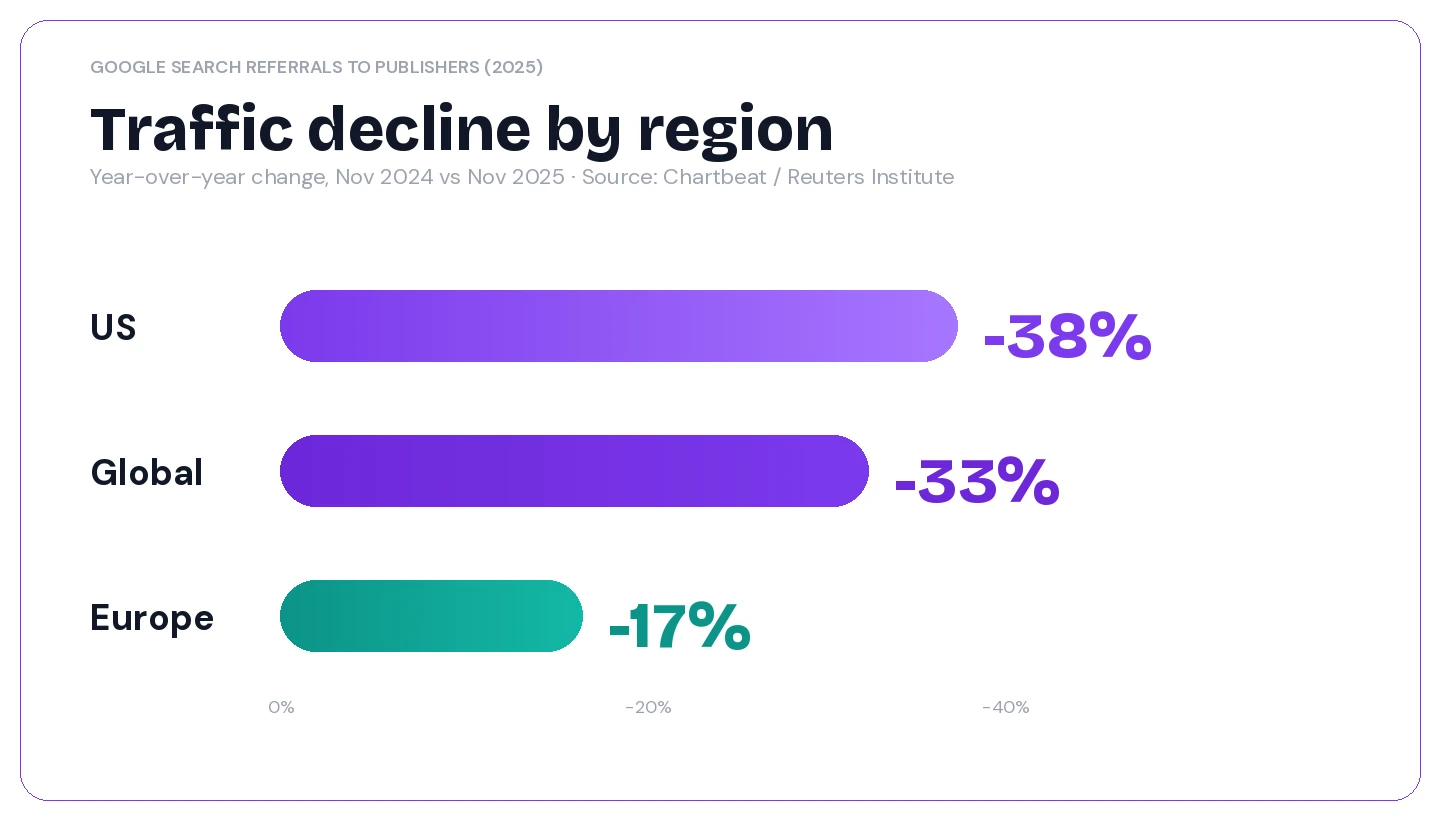
Chartbeat tracked 2,500+ news sites globally. Google search referrals dropped 33% in 2025. In the US? 38%. Europe got off a bit lighter at 17%. Mostly because AI Overviews hit the US harder and earlier.
Digital Content Next surveyed 19 big publishers. We’re talking NYT, Condé Nast, Vox-level names. The median decline from Google Search was -10% overall. News brands lost 7%. Non-news brands lost 14%. And for non-news? It was down every. single. week. No recovery. Just a line going down.
The worst weeks? News brands crashed 16%. Non-news dropped 17%. In a single week.
The Reuters Institute asked 280 media leaders across 51 countries what they expect going forward. The answer: search traffic will drop 43% within three years. One in five said they expect to lose more than 75%.
Read that again. These are CEOs and editors-in-chief. Not random doomers on Reddit. They’re planning for a world where Google sends them half the traffic it used to.
Some real stories that hurt to read
Numbers are one thing. Real businesses shutting down is another.
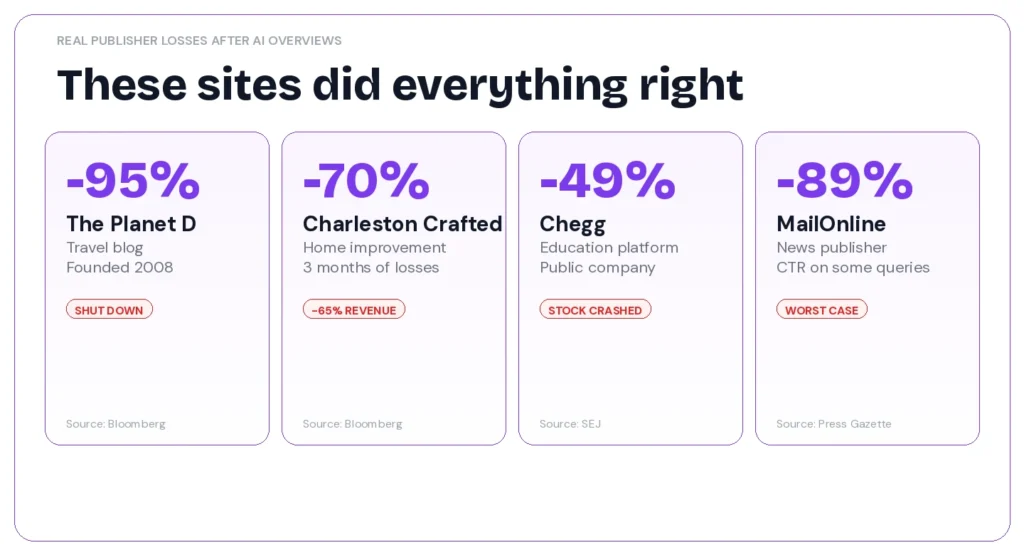
The Planet D. Travel blog, been around since 2008. Lost half their traffic after AI Overviews launched. Laid off staff. Traffic dropped another 90%. They shut down.
Charleston Crafted. Home improvement blog. Lost 70% of traffic in three months. Ad revenue dropped 65%.
Chegg. The education platform. Down 49%. Turns out when AI can answer homework questions directly on Google, nobody needs to click through anymore.
MailOnline saw CTR drop up to 89% on some queries. Eighty-nine percent.
These weren’t bad sites. They were established, well-built publishers who did everything right by the old rules. Didn’t matter.
Why it’s happening: nobody clicks anymore
The mechanic is simple. Google answers the question. User reads it. User leaves. Nobody clicks anything.
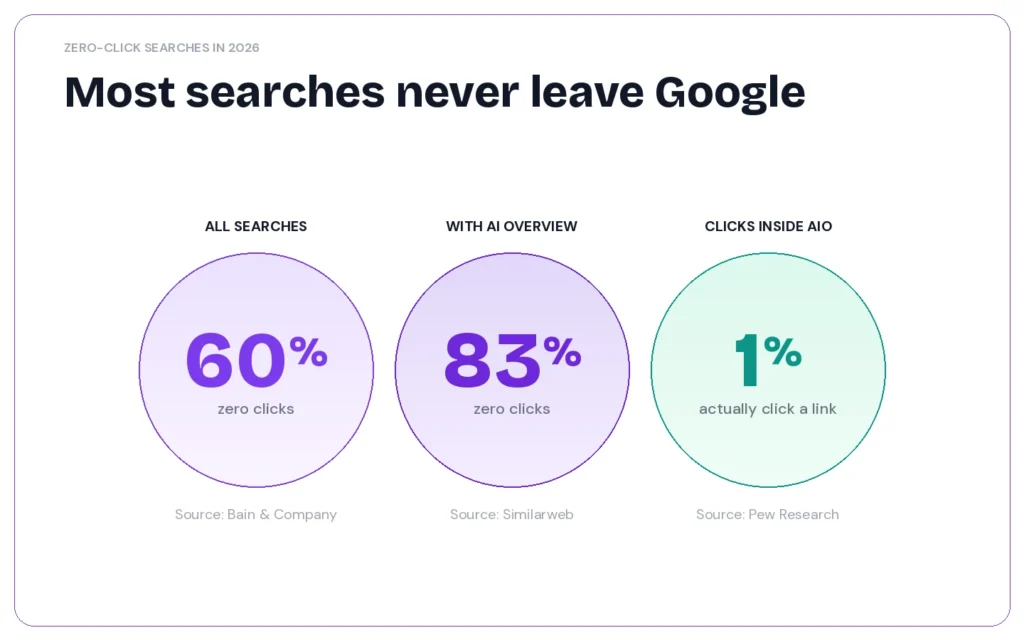
It has a name: zero-click search. And the numbers are wild.
- 60% of all Google searches now end without a single click. (Bain & Company)
- When an AI Overview is present? 83% zero-click rate. (Similarweb)
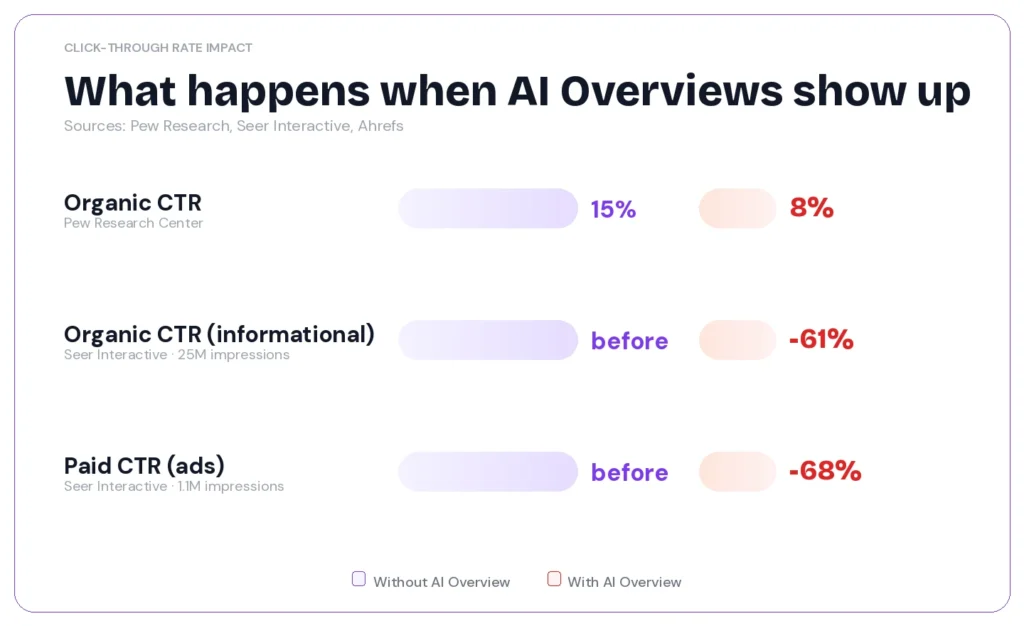
- CTR drops from about 15% to 8% when AI Overviews show up. (Pew Research Center)
- Only 1% of people click a link inside the AI Overview. One percent.
And it’s not just organic. Seer Interactive studied 25 million impressions across 42 organizations. Organic CTR on informational queries with AI Overviews? Down 61%. Paid CTR? Down 68%. Even ads don’t work as well anymore when AI gives the answer first.
As of this month, Ahrefs puts the overall click reduction at 58%.
What’s getting hit hardest
Not all content is dying equally. There’s a clear pattern.
Getting destroyed: Travel content. Recipe blogs. Celebrity/entertainment stuff. How-to guides with clear answers. Product comparisons. Car specs. Anything where AI can give a clean, short answer.
Holding up better: Breaking news. Opinion and analysis. Investigative stuff. Content where nuance matters. Bottom-funnel pages like detailed reviews, case studies, pricing pages. Things AI can’t confidently summarize in two sentences.
Here’s the ironic part. The content you optimized best for old-school SEO (clean structure, clear answers, well-organized) is exactly what’s easiest for Google to extract and serve without sending you the click. You made it too easy for them.
The CMA drama (happening literally right now)
This is the thing everyone in the industry is watching.
On January 28, the UK’s Competition and Markets Authority told Google: let publishers opt out of AI Overviews without losing their normal search rankings.
Big deal. Because right now your only option to block AI features is to block Googlebot entirely. Which means disappearing from search. Which means death. So nobody does it.
Google said they’re “exploring” it. Then on February 11, a senior Google exec called building an opt-out mechanism a “huge engineering project.”
The internet roasted them. One person put it perfectly: “AI can write thousands of lines of code, but letting publishers opt out is impossible?”
A poll of 350+ SEO pros showed about a third of publishers would opt out if they could. 42% said they wouldn’t. 25% are still thinking about it.
Google’s official line? Total search traffic hasn’t actually decreased. It’s just going to “different sources” now. Cool story. Tell that to the publishers watching their analytics crater.
The CMA consultation just closed. Decision expected mid-March. Actual opt-out tools? Maybe Q2 or Q3 2026. The EU is running a similar investigation. Penske Media is suing Google. Things are moving.
What the data says about surviving this
Okay, here’s the part that’s actually useful.
Not all the research is doom. Some of it points to what’s working. And there are patterns.
Structured content wins. Clear headings, FAQ blocks, clean H2/H3 hierarchy. AI systems need to extract information cleanly. If your article is a giant wall of text, you’re invisible to them. Structure your stuff so it’s easy to quote.
Your intro is everything. 44% of all LLM citations come from the first 30% of a text. Bury your answer in paragraph seven? Someone else’s intro gets quoted instead.
Getting cited in AI Overviews is actually great. If it’s you. When a brand gets cited, organic CTR goes up 35% compared to non-cited results. The AI Overview isn’t the enemy. Being ignored by it is.
Brand mentions > backlinks. Off-site brand mentions have the strongest correlation with appearing in AI Overviews. Stronger than backlinks. Stronger than domain authority. If nobody talks about you outside your own site, AI doesn’t trust you.
Fresh, deep content beats old SEO tricks. Recency, depth, and readability now matter more for AI citations than link profiles do. The old playbook is losing to the new one.
Traditional SEO still matters. But it’s not enough. 76% of URLs cited in AI Overviews also rank top 10 in regular search. So ranking is still the entry ticket. It just doesn’t guarantee you get the traffic anymore.
Bottom line
The old game? Publish content, rank on Google, cash the ad checks. It’s breaking. Not for everyone. Not on every query. But the trend is clear, it’s accelerating, and the data doesn’t leave much room for “maybe it’ll bounce back.”
The publishers who’ll make it are the ones adapting now. Building email lists. Diversifying traffic. Restructuring content so it gets cited, not just ranked.
The ones waiting for Google to fix this? Check back in a year and see how many are still around.