The 8-Step Guide to Getting Your Articles Cited by AI


How do you optimize an existing article so AI engines actually cite it?
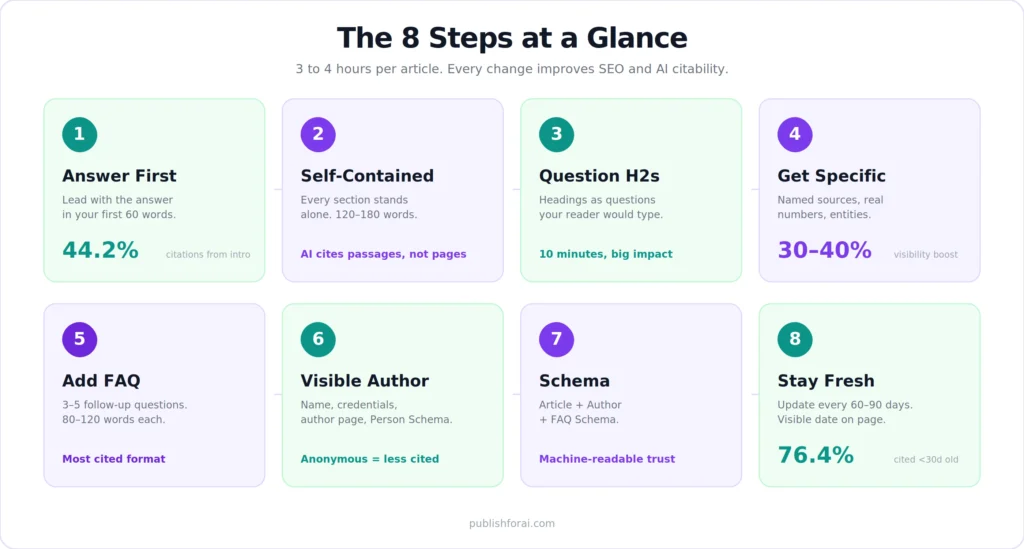
Eight steps: rewrite your opening answer-first, restructure every section into a self-contained unit of 120 to 180 words, turn your headings into questions, replace every vague claim with a named source and specific number, add a FAQ section, make your author visible and verifiable, implement Article, Author and FAQ Schema, and set a visible update date with a 60 to 90 day freshness cycle.
The Payoff is real…
Brands cited in AI Overviews earn 35 percent more organic clicks than non-cited competitors on the same queries, according to Seer Interactive’s analysis of 25.1 million organic impressions across 42 organizations.
The best part: every single one of these changes also improves your classic Google ranking. Two channels, one workflow.
I’ve been running this exact process across client portfolios for months. This post walks you through every step, with real before-and-after examples and the research behind each one. If you’ve read my last post on Google AI Overview, you know the problem. This is the solution.
Let’s get into it.
Why Does Optimizing Existing Articles Beat Writing New Ones?
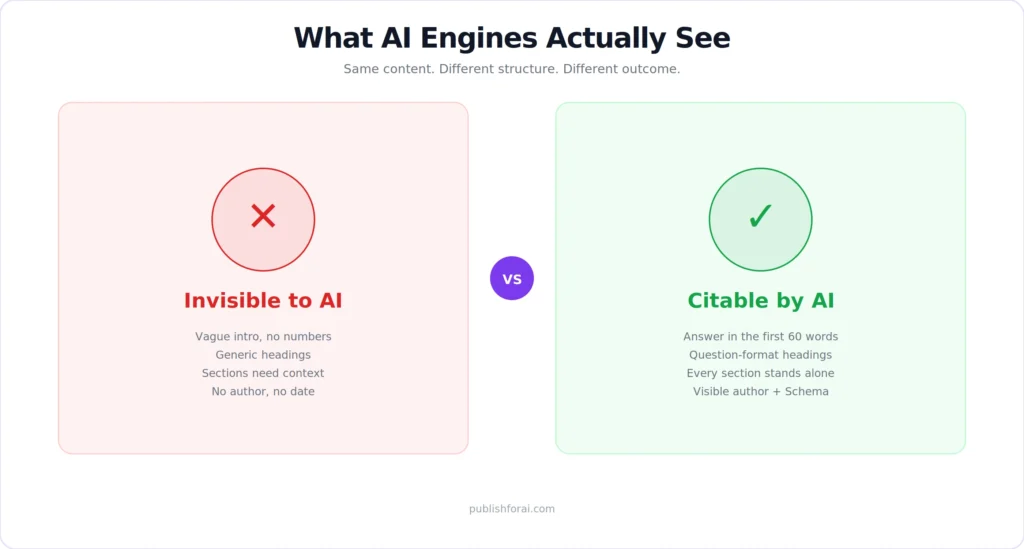
Optimizing an article that already ranks is faster, cheaper, and more effective than writing from scratch. The reason is simple: that article already has Google’s trust. It has backlinks, indexing history, and domain authority flowing through it. Throwing that away to start fresh is like demolishing a house because the kitchen needs an update.
A February 2026 analysis by Ahrefs found that AI Overviews now correlate with a 58 percent lower click-through rate for top-ranking pages. But here’s the flip side: Seer Interactive’s data from the same period shows that brands cited inside AI Overviews earn 35 percent more organic clicks than non-cited competitors.
Same search results page. Dramatically different outcomes depending on whether you’re cited or skipped. The difference comes down to content structure. And structure is something you can fix in an afternoon.
What Should I Check Before I Start Editing?
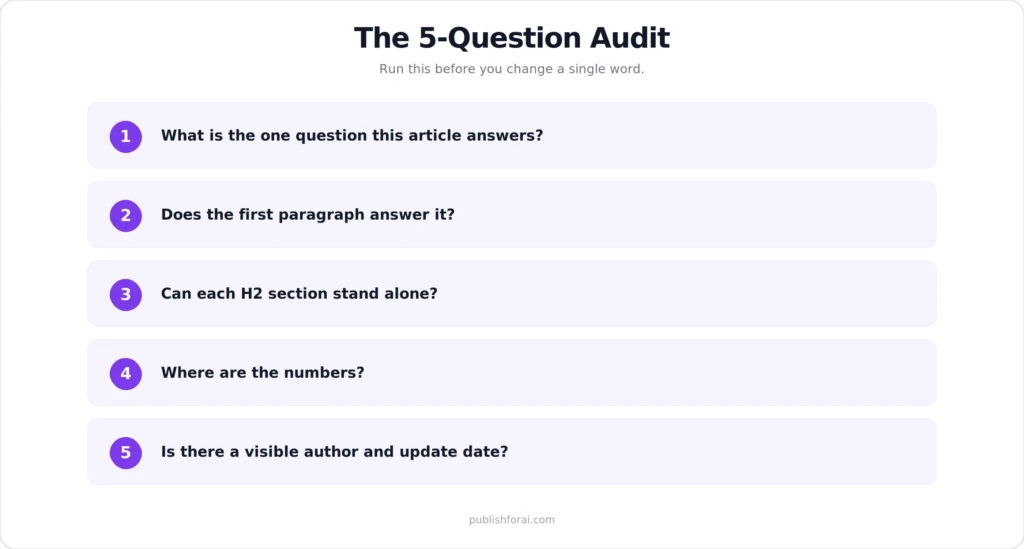
Every optimization starts with a five-question audit. Open the article in one tab, a blank document in another, and work through these:
Question 1: What is the one question this article answers? One specific question. If you can’t name it in a single sentence, the article has a focus problem that no structural fix will solve. Write the question down. Everything that follows serves this question.
Question 2: Does the first paragraph answer it? Read the first two sentences after the H1. If those sentences don’t contain a direct, quotable answer to the article’s core question, you’ve already found your first fix. A Growth Memo analysis of 1.2 million ChatGPT citations found that 44.2 percent of all citations come from the first 30 percent of a page’s text. Your intro is the most valuable real estate on the entire page.
Question 3: Can each H2 section stand alone? Copy any single section and paste it into a blank document. Does it make sense without the rest of the article? No forward references like “as we’ll see below”? No backward ones like “as mentioned earlier”? If a section can’t survive extraction, AI engines won’t extract it.
Question 4: Where are the numbers? Scan for specific data points: percentages, dates, study references, named sources. If you find phrases like “some experts say” or “studies show” without naming which experts or which studies, mark them. The Princeton GEO study presented at ACM KDD 2024 found that adding relevant statistics to content increased AI visibility by 30 to 40 percent. Vague claims score near zero.
Question 5: Is there a visible author and an update date? On the page, where people can see it. A named author with credentials, linked to an author page. A visible “Last updated” date. If either is missing, that’s a trust signal gap that costs you citations across every AI engine.
Write your answers down. You now have a prioritized repair list.
Step 1: How Do I Rewrite My Opening for Maximum Citability?
Lead with the answer in your first 40 to 60 words. This is the single highest-impact change you can make, because 44.2 percent of all LLM citations come from the first 30 percent of a page’s text, according to Kevin Indig’s analysis of 1.2 million ChatGPT responses.
Most articles open with context. “In today’s rapidly changing digital landscape…” or “Content marketing has evolved significantly over the past decade…” These are throat-clearing sentences. They tell AI engines nothing extractable.
The fix is an approach journalists have used for decades: answer first, explain after.
Before: “In recent years, search engines have been increasingly integrating AI into their results pages. This has led to significant changes in how content is discovered and consumed. Understanding these changes is critical for publishers who want to maintain their visibility.”
After: “AI Overviews now reduce organic click-through rates by up to 58 percent for top-ranking content, according to a 2026 Ahrefs analysis of 300,000 keywords. The traffic loss isn’t caused by ranking drops. Google is answering queries itself, directly in the search results, before users scroll to organic links.”
The first version says nothing an AI engine can cite. The second version is a self-contained, quotable statement backed by a named source and a specific number. That’s what extraction looks like.
Step 2: How Do I Structure Sections So AI Engines Can Extract Them?
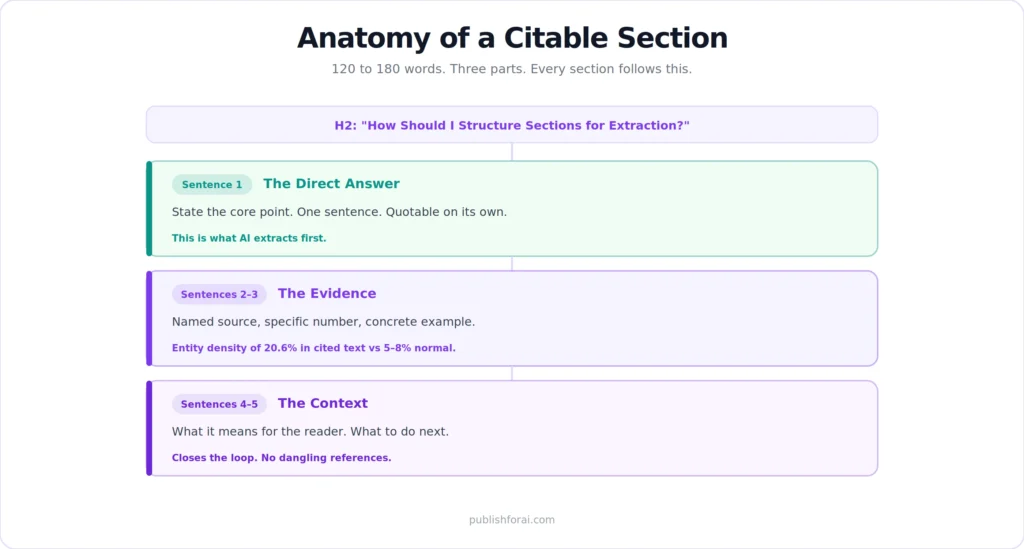
Each H2 section should be a self-contained unit of 120 to 180 words that makes complete sense if extracted in isolation. AI engines cite passages, not pages. When Google AI Overview or Perplexity builds an answer, it pulls specific sections from multiple sources and assembles them. If your section depends on context from three paragraphs earlier, it won’t get selected.
Here’s the three-part structure that works:
Sentence 1: The direct answer. State the core point in one clear sentence. No buildup. If someone reads only this sentence, they should understand the section’s main claim.
Sentences 2 to 3: The evidence. A specific number, a named study, a concrete example. This is where entity density matters. Kevin Indig’s analysis found that heavily cited passages have an entity density around 20.6 percent. Roughly one in five words is a specific name, brand, tool, date, or data point. Normal English text sits at 5 to 8 percent.
Sentences 4 to 5: The context or implication. What does this mean for the reader? What should they do with this information?
Multiple sources, including SE Ranking’s 2025 citation research, have confirmed that 120 to 180 words per section is the range where AI extraction performs best.
Step 3: Why Should I Turn My Headings Into Questions?
Question-format H2 headings get matched to user queries more directly, which increases extraction probability across all AI engines. This change takes ten minutes and has an outsized effect.
When someone asks Perplexity “How do I optimize an article for AI citation?”, the model scans for headings that closely match that query pattern. A heading like “How Do I Optimize an Article for AI Citation?” is a near-exact match. A heading like “Optimization Best Practices” requires the model to infer relevance. And models prefer sources that require less inference.
FAQ-style headings (questions that start with What, How, Why, Which) align naturally with how people phrase queries in both traditional search and AI chat interfaces.
Go through your article and rewrite every H2 as a question your reader would actually type. Instead of “Content Structure” try “How Should I Structure Content for AI Citation?” Instead of “Author Signals” try “Why Does Author Identity Matter for AI Visibility?”
One rule: keep the question genuine. If the heading asks a question the section doesn’t fully answer, rewrite the section too.
Step 4: How Do I Replace Vague Claims With Citable Ones?
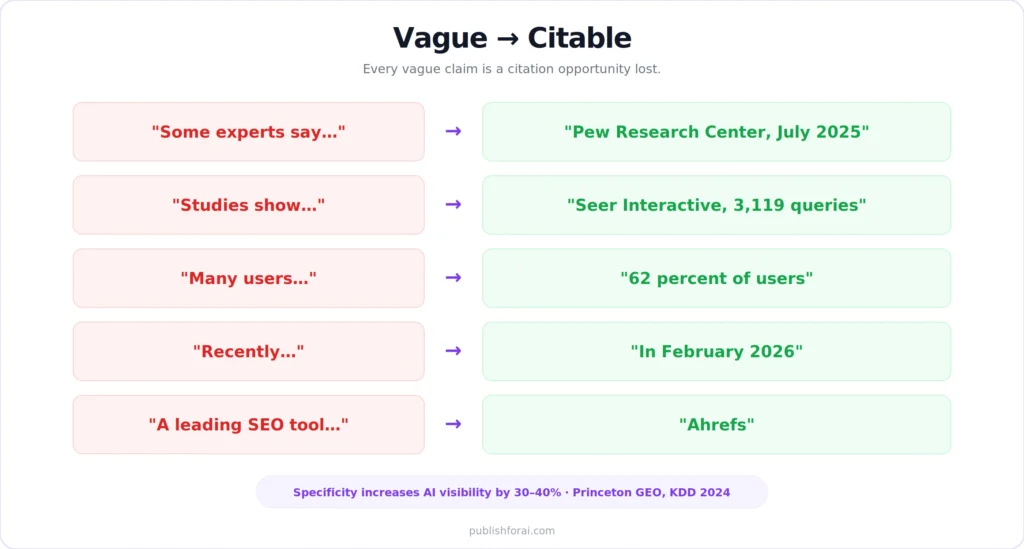
Replace every unattributed claim with a named source, specific number, or concrete entity. This is where most content fails the citability test. And it’s where the fix is most mechanical.
The Princeton University GEO study, published at ACM KDD 2024, tested this directly. Researchers applied nine different optimization strategies to web content and measured their effect on AI visibility. The three strategies that performed best (adding statistics, adding quotations from credible sources, and citing references) all increased visibility by 30 to 40 percent. Meanwhile, strategies focused on keyword optimization or generic fluency improvements showed little to no effect.
Here’s a practical find-and-replace list for your article:
“Some experts say” → name the expert. “According to Pew Research Center’s July 2025 study” is citable. “Some experts” is invisible.
“Studies show” → name the study. “A Seer Interactive analysis of 3,119 informational queries across 42 organizations” is citable. “Studies” is not.
“Many users” → use a number. “62 percent of users” gives AI engines something to extract. “Many” gives them nothing.
“Recently” → use a date. “In February 2026” pins the information in time. “Recently” could mean anything.
“Leading company” → name the company. “Ahrefs” is an entity. “A leading SEO tool” is a description no AI engine can map to its knowledge graph.
Go through your article line by line. Every vague claim is a citation opportunity lost.
Step 5: Why Should I Add a FAQ Section?
FAQ sections are one of the most consistently cited content formats across all AI engines because each question-answer pair is a self-contained unit that perfectly matches how AI models process queries.
Write three to five questions your reader would still have after finishing the article. The follow-up questions. The “okay, but what about…” questions.
Each answer should be 80 to 120 words. Direct, complete, no references to other parts of the article. Each answer should pass the extraction test: if someone reads only this answer with zero context, does it make sense?
Mark up the FAQ section with FAQ Schema. This structured data helps Google and other AI engines identify the question-answer pairs programmatically. It takes minutes to implement and it’s measurable in its effect.
Step 6: How Do I Make My Author Visible and Verifiable?
A named author with verifiable credentials, linked to a dedicated author page with Person Schema, is a trust signal that directly affects AI citation rates. Anonymous content gets cited less.
AI models evaluate trust through what Google calls E-E-A-T: Experience, Expertise, Authoritativeness, and Trustworthiness. Here’s what a complete author setup looks like:
On the article itself: An author name, a one-line bio, a link to a full author page. Visible on the page, near the top or prominently at the bottom.
On the author page: A photo, a bio that states specific credentials (“21 years in search, led organic strategy for global brands”), links to other published work, and links to social profiles where the author is active.
In the markup: Author Schema (Person Schema) connecting the author entity to the article. This gives AI engines a structured, machine-readable link between the content and the person behind it.
The combination matters. A named author with no author page is weak. An author page with no Schema is weaker than it needs to be. All three together create a trust signal stack that AI engines can verify.
Step 7: Which Schema Markup Do I Need?
At minimum, every optimized article needs three types of Schema: Article Schema, Author Schema (Person Schema), and FAQ Schema. Schema Markup is how you make your content machine-readable. AI engines can read natural language, sure. But structured data removes ambiguity and gives them explicit signals about what your content is, who wrote it, when it was published, and what questions it answers.
Article Schema tells AI engines the article’s headline, author, publication date, last modified date, and publisher. The “dateModified” field is particularly important. It’s a freshness signal that AI engines actively evaluate.
Author Schema (Person Schema) connects the author entity to the article with structured credentials. Name, job title, employer, social profiles, the “sameAs” property linking to other profiles across the web.
FAQ Schema marks up your FAQ section so each question-answer pair is explicitly identified. AI Overviews frequently pull directly from FAQ Schema because the format is already structured for extraction.
If your article includes how-to steps, add HowTo Schema as well. If you’re on WordPress, plugins like Yoast SEO or Rank Math can generate Article and FAQ Schema from your content. For Author Schema, you may need a custom JSON-LD block. But it’s a one-time setup per author that applies across every article.
Step 8: How Often Should I Update My Content for Freshness?
Update your highest-value articles every 60 to 90 days and make the update date visible on the page. Content freshness is a citation signal that matters more in AI search than it ever did in traditional SEO.
Research from Digitaloft found that 76.4 percent of ChatGPT’s most-cited pages were updated within the last 30 days. Seer Interactive’s data shows that 44 percent of AI Overview citations come from content published in 2025 alone. AI engines favor current information because their users expect current answers.
Add a visible “Last updated: [Month Year]” line near the top of your article. On the page, where both users and AI crawlers can see it.
You don’t need to rewrite the entire piece. A freshness update can be as simple as adding a new statistic, updating a data point, replacing an outdated reference, or adding a new section that reflects recent developments. The point is to signal, both to AI engines and to readers, that this content reflects the current state of the topic.
What Does the Complete Workflow Look Like?
Here’s the full process, condensed into six phases you can repeat for any article. Total time: roughly three to four hours.
Phase 1: Audit (30 minutes). Run through the five audit questions. Identify the core question, check the opening, test section independence, scan for specificity, verify author and date visibility.
Phase 2: Restructure (60 to 90 minutes). Rewrite the opening paragraph answer-first. Restructure each H2 section into the three-part format: answer, evidence, context. Convert headings to questions. Keep sections within 120 to 180 words.
Phase 3: Sharpen (45 to 60 minutes). Replace every vague claim with a specific one. Add named sources, numbers, dates. Increase entity density throughout.
Phase 4: Extend (30 to 45 minutes). Add or improve the FAQ section. Ensure three to five genuine follow-up questions with self-contained answers.
Phase 5: Trust layer (30 minutes). Verify author visibility and author page. Implement or update Article, Author, and FAQ Schema. Set the visible update date.
Phase 6: Validate (15 to 30 minutes). Read the article as if each section were extracted and shown in isolation. Does every section pass the standalone test? Is the first paragraph citable? Are there any remaining vague claims?
For a high-value article that’s already ranking, that’s a strong return on investment.
Which Tools Help With AI Citation Optimization?
The three tool categories you need are: technical SEO plugins for Schema, content analysis tools for structure, and a combined SEO/GEO platform for citability scoring. Here’s what I’d recommend depending on where you are:
For Schema Markup and technical SEO foundations: Yoast SEO or Rank Math. Both handle Article Schema, FAQ Schema, and the technical basics well. Solid tools. Neither analyzes AI citability though.
For content structure and keyword alignment: Surfer SEO or Frase. Good for content briefs and understanding what’s ranking for your target keyword. Helpful for the traditional SEO layer. They don’t evaluate whether your content is structured for AI extraction.
For the combined SEO and GEO workflow: Publish for AI. You import an existing article, get a combined SEO and GEO score, and see exactly which sections are too vague, too long, or too poorly structured to be cited. And it simultaneously flags classic SEO issues.
It runs the audit I described above, automated and against your specific keyword’s competitive landscape. One pass covers both channels. That’s the workflow I built this process around, and it’s the one I use now instead of doing the manual version.
What Does a Before-and-After Actually Look Like?
Here’s a real example. Take a common article opening about email marketing best practices.
Before optimization:
“Email marketing continues to be one of the most effective digital marketing channels available today. In this comprehensive guide, we’ll explore the best practices that leading marketers use to improve their email campaigns. Whether you’re just starting out or looking to refine your approach, these tips will help you get better results.”
After optimization:
“Email marketing generates an average return of 36 dollars for every dollar spent, according to Litmus’s 2023 State of Email report. That’s the highest ROI of any digital marketing channel. The gap between campaigns that hit that benchmark and campaigns that underperform comes down to five structural practices: list segmentation, send time optimization, subject line specificity, mobile-first design, and automated behavioral triggers.”
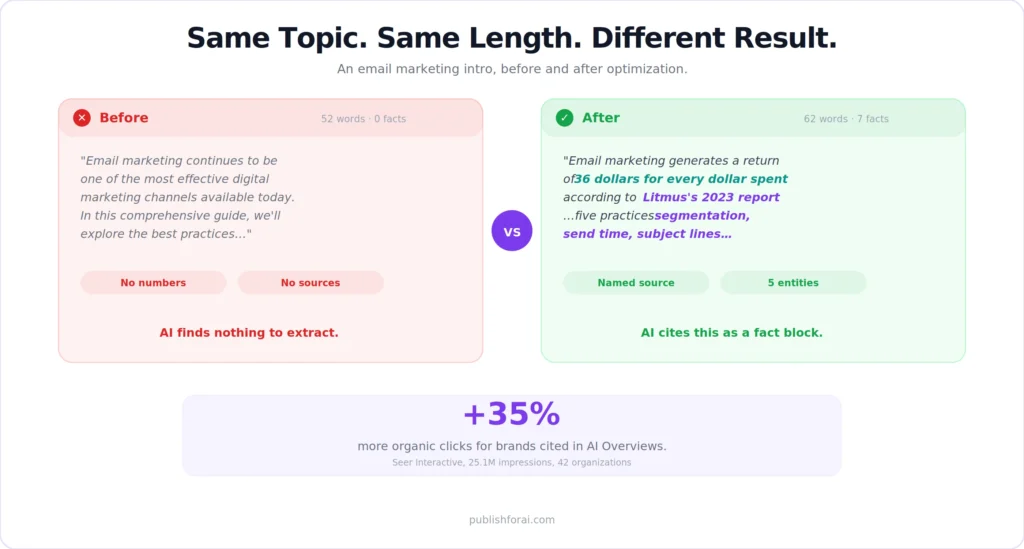
The first version is 52 words that say nothing specific. No AI engine can extract a usable fact from it. The second version is 62 words packed with a named source, a specific number, and five concrete entities. It answers the implied question in a single, self-contained paragraph.
That’s the difference. And it’s a difference you can create in every section of every article.
The Bottom Line
Optimizing existing articles for AI citation isn’t a separate project from SEO. It’s the same project, extended to cover how search actually works in 2026.
Everything in this guide (answer-first structure, self-contained sections, specific claims, visible authorship, structured data, fresh content) also improves your classic Google ranking. That’s no coincidence. What makes content trustworthy and useful to AI engines is the same thing that makes it trustworthy and useful to humans.
Start with your best-performing article. The one with the most traffic, the strongest ranking, the highest business value. Run the audit. Apply the six phases. Then do the next one.
In 21 years of search, I’ve learned one thing consistently: the publishers who adapt first don’t just survive shifts. They gain ground while others are still debating whether the shift is real.
This shift is real. And the articles you optimize today will be the ones AI engines cite tomorrow.
👉 Run your first article through Publish for AI and see exactly where it stands. What’s already citable, what’s not, and what to fix first.
Key Takeaways
• Optimizing existing articles is faster and more effective than writing new content. You keep the SEO equity you’ve already built.
• The opening paragraph is the single most valuable section: 44.2 percent of all LLM citations come from the first 30 percent of a page.
• Every H2 section should be a self-contained unit of 120 to 180 words that makes sense if extracted in isolation.
• Replacing vague claims with specific data points, named sources, and concrete entities increases AI visibility by 30 to 40 percent.
• A visible author with verifiable credentials, linked to an author page with Schema Markup, is a trust signal every AI engine evaluates.
• FAQ sections with three to five question-answer pairs are one of the most consistently cited content formats.
• Update your highest-value articles every 60 to 90 days. Over 76 percent of ChatGPT’s most-cited pages were updated in the last 30 days.
FAQ
Does this optimization process work for all types of content?
This process works best for informational content: guides, how-tos, explainers, and educational articles. These are the content types most frequently targeted by AI Overviews and most often cited by ChatGPT and Perplexity. Transactional pages like product or booking pages are less affected by AI citation because AI engines generate fewer summaries for purchase-intent queries. If your article answers a question, this process applies.
How quickly will I see results after optimizing an article?
Faster than classic SEO changes. AI Overviews reflect content changes within days to a few weeks because they’re based on Google’s current index. Perplexity indexes even faster. Most publishers I’ve worked with see citation changes within two to four weeks of publishing an optimization. Schema Markup and freshness signals tend to register within the first crawl cycle.
Can I over-optimize and hurt my existing rankings?
The structural changes described here (answer-first openings, self-contained sections, specific claims, Schema Markup) are the same signals Google rewards in traditional rankings. There’s no conflict between SEO and GEO optimization when done correctly. The real risk is under-optimization: making cosmetic changes without addressing the structural issues that determine whether AI engines extract your content or skip it.
Should I optimize all my articles or just the top performers?
Start with your top performers. Articles that already rank well have the most to gain from AI citation optimization because they’re already in the pool of pages AI engines consider. A page ranking on page three has a ranking problem. Fix that first, then optimize for citation. For most publishers, the top 10 to 20 articles by traffic cover the majority of their visibility. Start there.
What’s the difference between GEO and traditional SEO?
SEO optimizes for Google finding and ranking your page. GEO optimizes for AI engines citing your page in their generated answers. They share the same foundation: clear structure, trustworthy authorship, technical fundamentals, depth, and freshness. GEO adds answer-first formatting, self-contained sections, entity optimization, extractable passage length, and visible author identity. The two disciplines complement each other. And in 2026, doing only one means leaving half your potential visibility on the table.
Do I need to add Schema Markup if I already have a good SEO plugin?
An SEO plugin like Yoast or Rank Math handles basic Article Schema and can generate FAQ Schema from your content. That covers the foundation. But Author Schema (which connects the person entity to the article with structured credentials and cross-references) often requires manual implementation or a dedicated JSON-LD block. The plugin handles the floor. You may need to build the ceiling yourself, especially for the author trust signal.
Sources Referenced in This Article
• Ahrefs. “AI Overviews Reduce Clicks by 58%.” February 2026
• Pew Research Center. AI Overview CTR study, July 2025 (68,000 real search queries)
• SE Ranking. Citation data and optimal section length research, 2025
• Digitaloft. ChatGPT content freshness and citation research, 2025