
The 5-Article Strategy: Why One Topic Cluster Beats 20 Random Optimizations


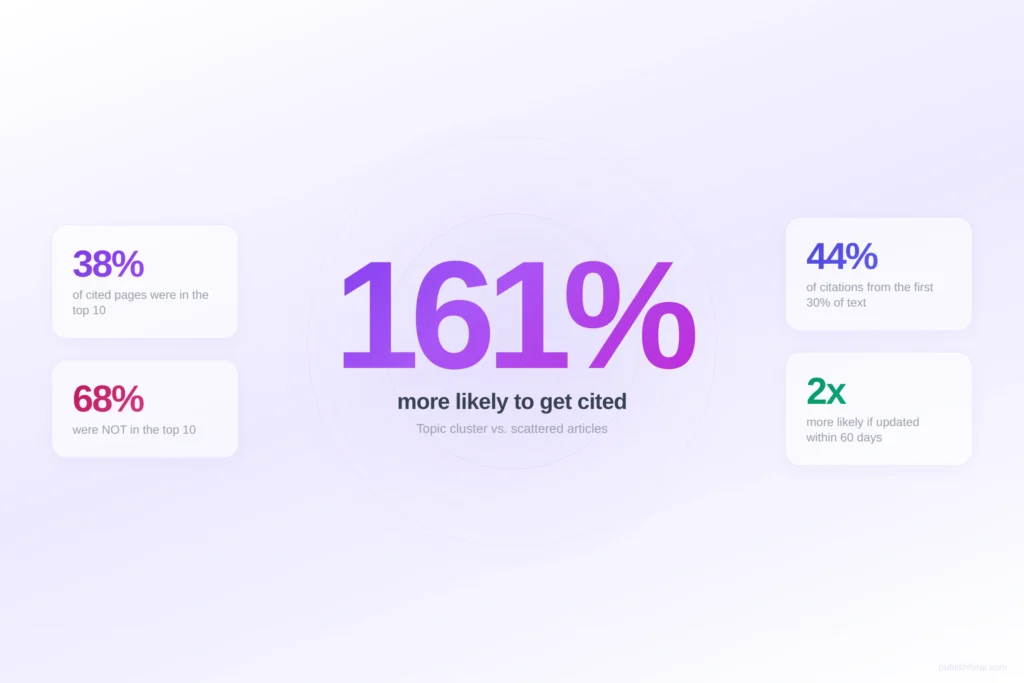
Optimizing five articles in one topic cluster makes you 161% more likely to get cited by AI search than optimizing five unrelated articles across your blog. That’s the result of a Surfer SEO study analyzing over 173,000 URLs. AI search doesn’t evaluate individual pages. It evaluates topics. And when you scatter your effort, no single topic gets strong enough for AI to notice you.
I Optimized 12 Articles. Nothing Happened. Then I Changed One Thing.
When I first started optimizing my Nomadmum blog, I did what felt logical: I picked articles from across my site. One about Koh Samui things to do. One about Thailand visa rules. One about flying with toddlers. One about Bali with kids.
I optimized each one. The scores looked good. I published the updates and waited. Two months later? Almost nothing moved. Zero new AI citations.
Then I tried something different. I picked one topic — family travel in Koh Samui — and optimized every article I had about it. Five posts, five angles of the same destination. Family hotels, best beaches, getting there, rainy day indoor playgrounds, and kid-friendly day trips.
Within five weeks, Perplexity started citing my Koh Samui content. Not one article. Three of them. For different queries. The cluster worked where the scattered approach hadn’t.
Why This Works: AI Doesn’t Read Your Page. It Reads Your Topic.
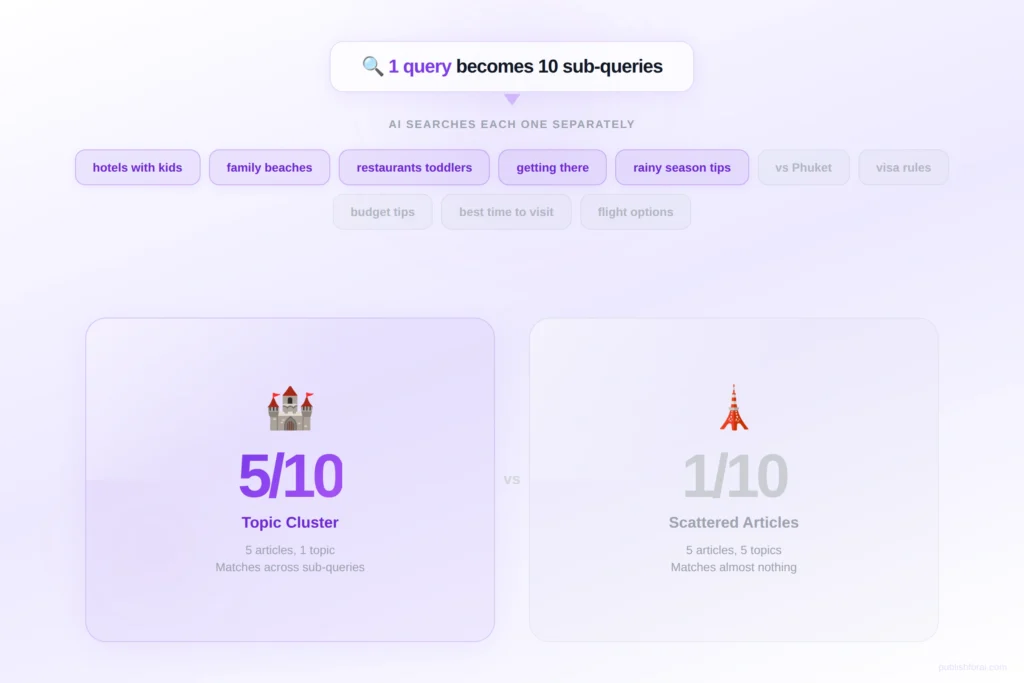
When someone asks Google a question and an AI Overview appears, Google doesn’t just scan the top 10 results. It does something called query fan-out: it breaks the question into 8 to 12 sub-queries, searches the web for each one separately, and assembles the answer from the best sources across the entire set.
Google confirmed this at I/O 2025. Head of Search Elizabeth Reid explained it plainly: AI Mode breaks your question into subtopics and issues a multitude of queries simultaneously on your behalf.
The consequence is massive. An Ahrefs study of 863,000 keywords found that only 38% of pages cited in AI Overviews also ranked in the top 10 for the original query. That’s down from 75% in mid-2025. And a Surfer SEO analysis found that 68% of cited pages were not in the top 10 at all. They got cited because they ranked for the sub-queries.
This is why clusters work. When AI fires 12 sub-queries about your topic and you have five articles covering five different angles, you’re a candidate across most of those sub-queries. When you have one lonely article? You’re a candidate for maybe one.
How The 5-Article Strategy Works
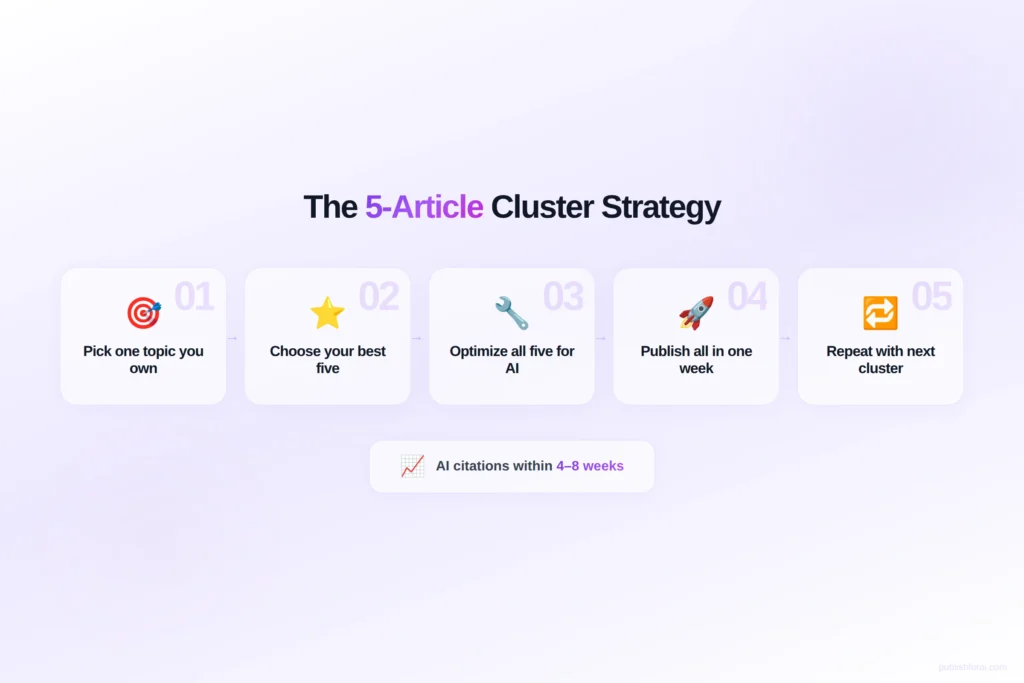
Step 1: Pick One Topic You Already Own
Look at your existing content. Where do you have four to eight articles around the same theme? You’re looking for a cluster where you already have depth, just not the structure AI needs. On Nomadmum, I had seven Koh Samui articles scattered across different categories. They’d never been treated as a cluster.
Step 2: Choose Your Best Five
Start with the articles that already get traffic or that cover the most important sub-questions in your topic. These are your highest-leverage pieces. Don’t start with the weakest ones.
Step 3: Optimize All Five For AI Extraction
Run each one through the optimizer. Implement the key outputs, especially the intro paragraph, the answer blocks, and the H-tag structure. Remember: 44% of all LLM citations come from the first 30% of a text. If your answer is buried in paragraph three, someone else’s intro gets quoted. Start every section with a direct, quotable statement.
Step 4: Publish All Updates In The Same Week
When five pages in the same topic all get refreshed within days, it sends a concentrated freshness signal to crawlers. Pages updated within 60 days are nearly twice as likely to appear in AI answers. Five scattered updates across five topics can’t produce that effect.
Step 5: Repeat With The Next Cluster
Once the first five are live, pick the next topic. One cluster is a test. Three clusters is a strategy. Five clusters is a content moat. The compound effect across multiple clusters is where the real transformation happens.
Why Random Optimization Doesn’t Compound
When you optimize one article about dog food, then one about travel insurance, then one about productivity apps, you’re building three isolated signals. None reinforce each other. AI sees three unrelated pages, not a pattern of expertise.
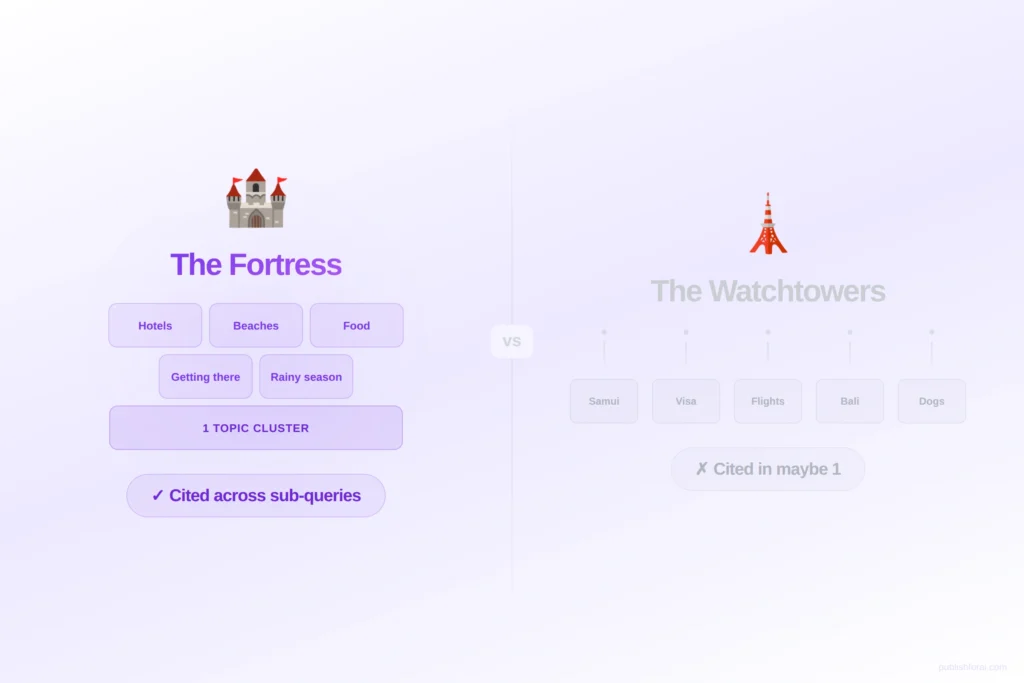
Topic clusters work because AI evaluates topical authority: your depth and consistency within a subject, not your breadth across many. Five optimized articles on one topic build a fortress. Five scattered articles build five lonely watchtowers. The fortress gets cited. The watchtowers get ignored.
I made this mistake for two months. The moment I switched to clusters, the results followed. Not because the individual articles got better. Because the topic got stronger.
The Window Is Open. It Won’t Be Forever.
Around 93% of AI search sessions end without a click. AI Overviews reduce clicks to the top-ranking page by 58%. The only pages that benefit are the ones getting cited inside those AI answers.
At the same time, ads are coming to AI search. Google started testing sponsored placements in AI Mode in February 2026. OpenAI has confirmed ads are coming to ChatGPT. The window for building organic AI visibility is closing.
You don’t need to optimize your entire blog this month. You need to own one topic. Find the cluster. Pick five articles. Optimize them. Publish in one week. I know it works because I tried both approaches. The cluster won.
Ready to start your first cluster? Optimize your next article!
Key Takeaways
✓ AI search evaluates topics, not pages. Google’s query fan-out breaks every question into 8–12 sub-queries. Topic clusters put you in front of more sub-queries than scattered articles ever could.
✓ Pages ranking for fan-out sub-queries are 161% more likely to get cited in AI Overviews. You can get cited without ranking for the primary keyword at all.
✓ The overlap between top-10 rankings and AI citations dropped from 75% to as low as 17–38%. Ranking well no longer guarantees AI visibility. Topical depth does.
✓ The strategy: pick one topic, choose five articles, optimize for AI extraction, publish updates in one week, repeat.
✓ 44% of all LLM citations come from the first 30% of a text. Nail your intro. Answer first, context second.
✓ Freshness amplifies clusters. Pages updated within 60 days are nearly 2x more likely to appear in AI answers.
✓ Ads are coming to AI search. The window for organic AI visibility is closing. Build topical authority now.
FAQ
What Is Query Fan-Out And Why Does It Matter For My Blog?
Query fan-out is how AI search engines break a single question into 8 to 12 sub-queries, search for each separately, and assemble the answer from across all results. Google confirmed this at I/O 2025. It matters because your content competes across a dozen related questions, not just one keyword. Topic clusters give you coverage across those sub-queries. Single articles don’t.
How Many Articles Do I Need In A Topic Cluster?
Five is the sweet spot for getting started. Enough to cover the main sub-questions AI generates, without being overwhelming. Quality and coverage matter more than volume. You’re not aiming for fifty — you’re aiming for five that each answer a different angle of the same subject.
What If I Don’t Have Five Articles On One Topic Yet?
Start with what you have. Optimize your existing articles as a group, then plan new ones to fill the gaps. Look at what sub-questions your content doesn’t cover yet — those gaps are your writing assignments. The cluster doesn’t have to be complete on day one.
How Long Before I See Results?
In my experience, four to eight weeks for initial AI citation changes. The speed depends on crawl frequency, topic competitiveness, and your existing domain signals. Freshness helps — updated content gets recrawled faster.
Can Small Bloggers Make This Work?
Yes. AI evaluates page-level and topic-level quality, not just domain size. Small bloggers with genuine niche expertise and structured, clustered content can outperform larger sites that cover topics superficially. Depth beats breadth.
What’s The Single Most Important Thing To Get Right?
Pick the right topic. Choose the one where you already have the most content, the most expertise, and the most realistic chance of being the best source. Your first cluster should be the one you can win.