What Is E-E-A-T And Why Should Every Blogger Care?


What Is E-E-A-T?
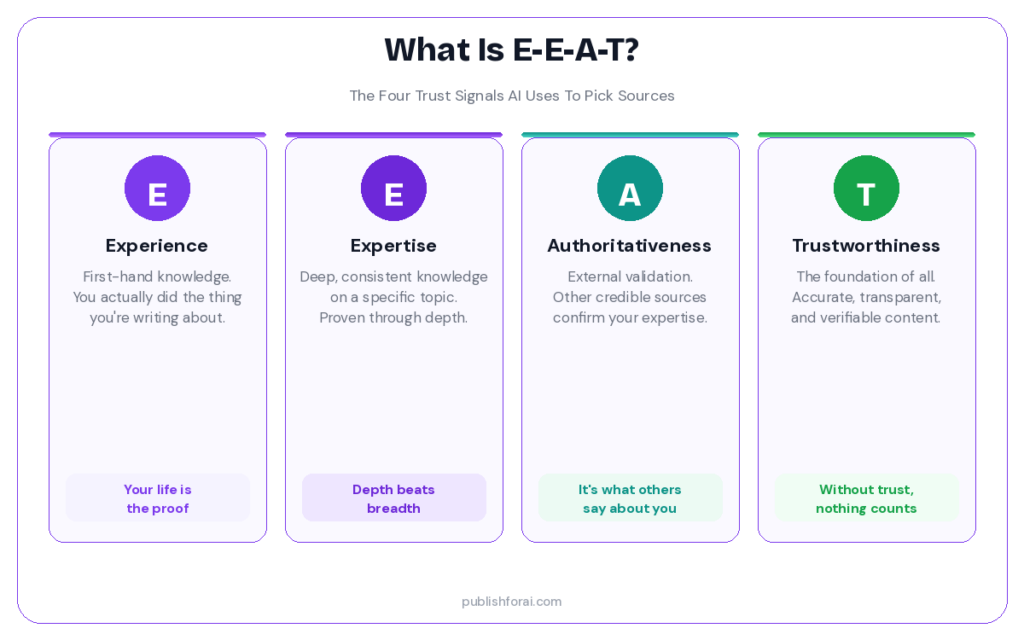
E-E-A-T stands for Experience, Expertise, Authoritativeness, and Trustworthiness. It’s Google’s framework for deciding whether your content deserves to be shown to anyone. And now every major AI engine — Google AI Overviews, ChatGPT, Perplexity, Claude — uses the same kind of trust logic to pick which sources to cite.
If your pages don’t send clear trust signals, AI skips you. Doesn’t matter how well your article is written or how long you’ve been publishing. If you look like every other generic site, you’re invisible.
I Had To Learn This The Painful Way
When I started Nomadmum.com back in 2019, I was overwhelmed. Completely. I had quit my journalism career in Germany, moved to Thailand with my husband and our little daughter, and thought: Okay, I’ll build a blog. How hard can it be?
Turns out: very hard. But I figured out the SEO game. I learned about keywords, headings, internal links, image optimization. I wrote clean, structured articles about family travel in Thailand. Over the years, I built real traffic. Real readers. Real income.
Then AI Overviews launched. And my traffic dropped. Not a little. A lot.
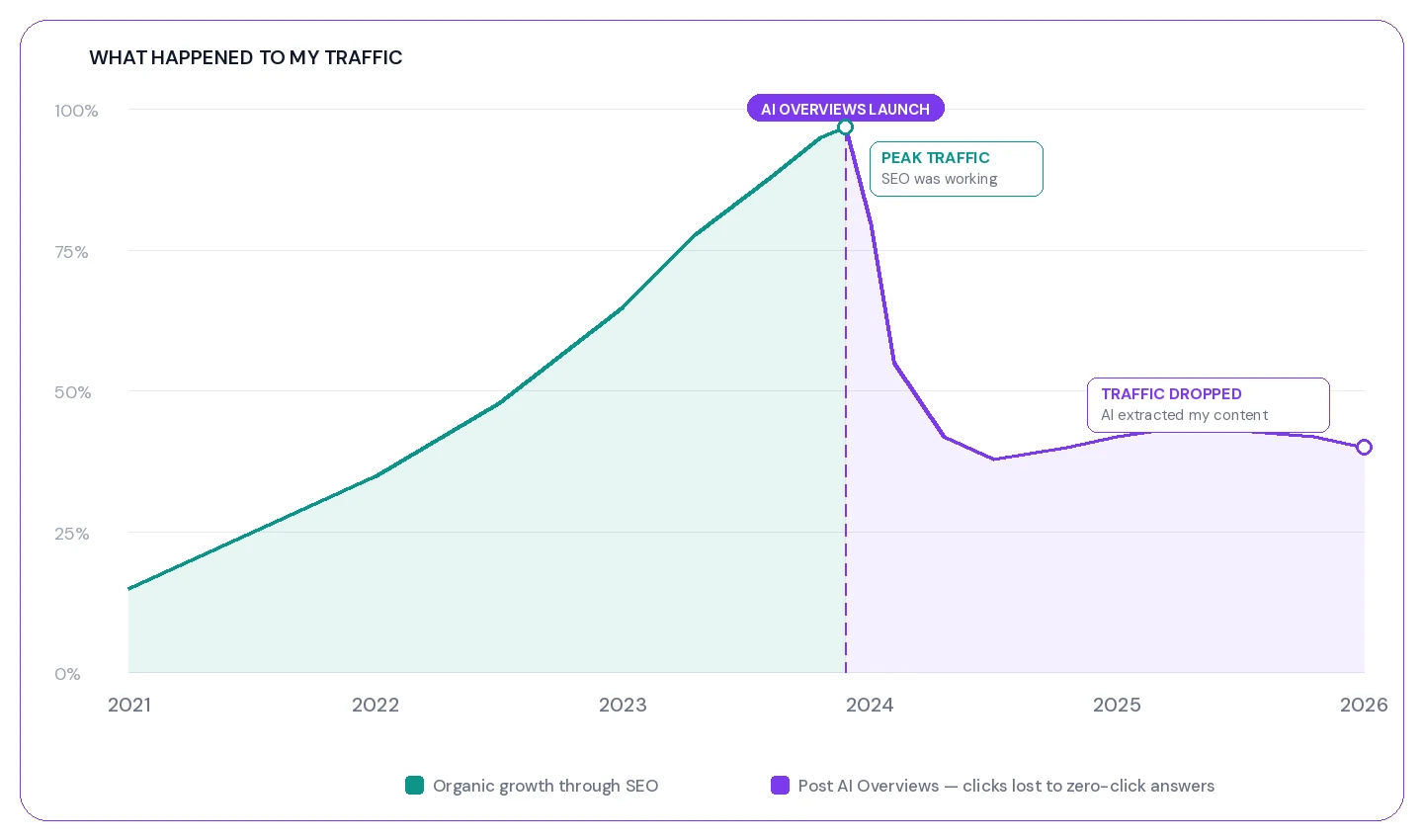
Here’s the ironic part. The content I optimized best for old-school SEO was exactly what Google found easiest to extract and serve without sending me the click. I made it too easy for them.
So I started digging. Not into more keyword tools. Into how AI engines actually choose which source to quote. And the same four letters kept coming up everywhere: E-E-A-T.
This post is everything I’ve learned since. What E-E-A-T signals actually mean, how each AI engine uses them differently, and what bloggers like you and me can do right now to stop being invisible.
Experience: Your Biggest Weapon Against AI Content
Experience is the first “E” in E-E-A-T. And it’s the one that kills most AI-generated content.
Google’s Search Quality Rater Guidelines reward content written by someone who actually did the thing. Used the product. Visited the place. Lived there with two kids and knows which restaurants actually have high chairs and which beach has a current that’s too strong for a three-year-old.
That last part? That’s literally my life. When I write about Koh Samui or Phuket or Bangkok, I’m not pulling from ten other travel blogs. I live in Thailand. My girls grew up here. I know which hotel pool has a shallow end for toddlers and which “family-friendly” resort absolutely isn’t.
A language model can’t write that. That’s the whole point.
As a blogger, I used to think my writing quality was my competitive edge. It’s not anymore. My lived experience is. And AI systems are getting better at telling the difference.
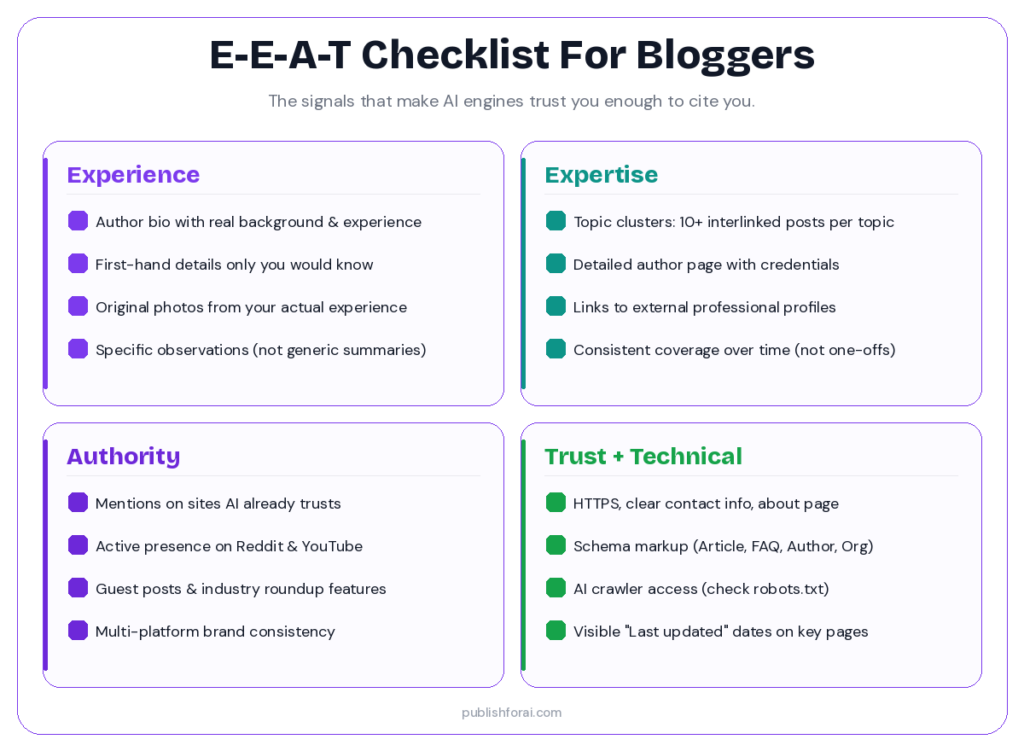
What to do. Make experience visible. Author bios that mention relevant background. Details only someone who was actually there would know. Original photos. The weather that day. The detour you had to take. The restaurant that was closed on Mondays. If you’re a travel blogger, a food blogger, a parenting blogger — your real life is your biggest SEO asset now. Use it.
Expertise: One Article Won’t Cut It
Expertise isn’t about slapping a credential in your bio and calling it a day. AI systems evaluate it through patterns. Does this author write about this topic regularly? Does the site cover related subjects in depth? Are the claims specific and consistent?
Google’s Knowledge Graph uses entity resolution to connect author profiles across platforms. If your author has a verifiable LinkedIn, published work elsewhere, and gets mentioned on other sites, their content carries more weight than the same text published anonymously.
I noticed this with Nomadmum. For a long time, I had scattered articles about different countries, different topics. A bit of everything. When I started focusing on Thailand — going deep with 30+ interconnected posts about destinations, visa guides, family life — something shifted. AI started treating me differently. One post about Phuket doesn’t signal expertise. But a whole ecosystem of Thailand content, linked together, written by the same person who actually lives there? That’s when it clicked.
As a solo blogger, this was honestly frustrating at first. I wanted to write about everything. But depth beats breadth now. And AI rewards consistency over variety.
What to do. Build topic clusters. Don’t write one article about a subject — write ten. Create a hub page with supporting posts. Interlink everything. Build detailed author pages with real credentials and links to your external profiles. AI notices when a site has depth on a topic, not just a single drive-by post.
Authoritativeness: What Other People Say About You
You can call yourself an expert all day. Doesn’t matter. Authority in E-E-A-T is external. It’s other people confirming you know what you’re talking about.
Backlinks from reputable sites. Citations in industry roundups. Mentions in news coverage. References on educational or government pages. These are the signals.
For AI specifically, this is huge. Research shows AI systems scan for agreement across multiple independent sources before citing a brand. If your content shows up consistently across Reddit, YouTube, industry publications, and review sites — all saying similar things about you — AI gains confidence. They call it the “consensus signal.” No external validation? AI treats your claims with skepticism. Simple as that.
Only 11% of domains get cited by both ChatGPT and Perplexity. The ones that do? Massive multi-platform presence.
This was a wake-up call for me. For years, I focused almost entirely on my own blog. My own little world. I didn’t guest post much, didn’t do digital PR, wasn’t active on Reddit or YouTube. And it showed. If the only place calling you an expert is your own about page, that’s not authority. That’s just marketing.
What to do. Get mentioned on sites AI already trusts. Contribute to industry publications. Write for roundups. Be active on Reddit and YouTube — two of the most-cited platforms across every AI engine. Build a presence that exists outside your own domain. For bloggers, this also means being part of a community, not just running a solo operation.
Trustworthiness: The One That Outranks Everything
Google’s own guidelines say it directly: Trust is the most important member of the E-E-A-T family. Without it, nothing else matters. You can be experienced and expert and authoritative, and if your site looks sketchy, AI won’t touch you.
Trust gets evaluated through layers. HTTPS. Transparent ownership. Clear editorial policies. Accurate, up-to-date information. No deceptive practices.
But here’s the part most bloggers miss: AI engines also evaluate tone. Content that’s overly promotional, pushy, or aggressive gets deprioritized. Not because it’s wrong. Because it’s hard for AI to safely reuse. If a machine is stitching together an answer from your text, it needs language it can quote without introducing bias. Neutral, factual content wins.
I had to rethink some of my own posts because of this. A few of my older articles were heavy on affiliate pushes and light on actual information. They might have converted well once. But AI doesn’t cite a sales pitch.
What to do. Make sure your site has clear contact info, a real about page, a visible correction or update policy, and HTTPS. Remove or update anything outdated. Use a balanced, factual tone on any page you want AI to cite. Add visible “Last updated” dates. These are small things that compound into serious trust.
How Each AI Engine Picks Who To Cite
They’re not all the same. And understanding the differences matters.
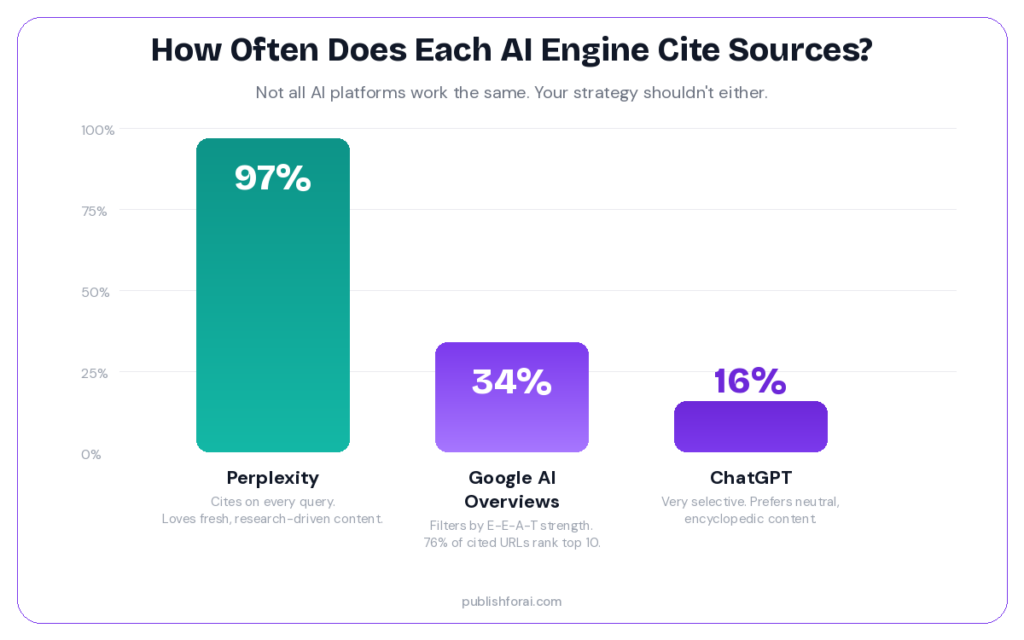
Google AI Overviews pull mostly from pages that already rank well in organic search, then filter by E-E-A-T strength. Schema markup helps. Content with clear headings and concise answer paragraphs of 40–60 words performs best. About 76% of cited URLs also rank in the top 10 organically. So traditional SEO is still the entry ticket. It just doesn’t guarantee the click anymore.
Perplexity runs a fresh web search for every single query and cites sources in 97% of responses. It loves research-driven pages, original reporting, and clearly attributed information. Freshness matters a lot here. Domain authority matters too — Perplexity doesn’t cite random blogs.
ChatGPT cites sources in roughly 16% of responses. It favors pages that define concepts clearly, avoid strong opinions, and use consistent language. Wikipedia is its most-cited source overall. That tells you everything about the tone and neutrality it’s looking for. About 24% of ChatGPT responses don’t pull from the web at all — so when it does cite, it’s very selective.
I tested this myself. I searched for topics I’d written about on all three platforms. Perplexity picked me up on a few Thailand queries. ChatGPT? Nothing. Google AI Overviews? Sometimes, but only on posts where I had really nailed the structure. That’s what made me realize: you can’t just “do SEO” anymore. You have to think about each engine separately.
Structure Matters More Than You Think
E-E-A-T signals don’t help if your content is a wall of text that AI can’t parse.
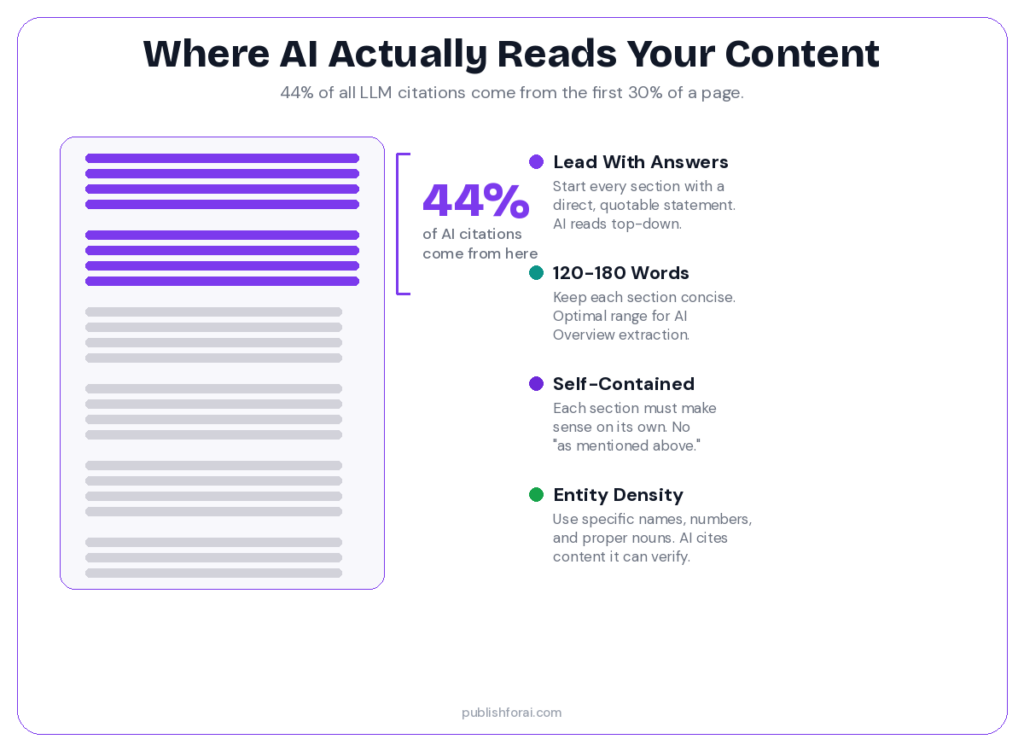
AI systems are top-heavy readers. They pull from the first sentences under each heading. If your best information is buried in paragraph seven, someone else’s intro gets quoted instead. Data backs this up: 44% of all LLM citations come from the first 30% of a page.
Start every section with a direct, quotable answer. Keep sections between 120–180 words. Make each one self-contained — if AI extracts just that block, it should make sense on its own. No “as mentioned above.” No “like we discussed earlier.” Each section is its own island.
Use specific names, numbers, and proper nouns. AI cites content with higher entity density. “Bangkok’s Chinatown (Yaowarat)” gets cited. “The old part of the city” doesn’t. “Koh Samui’s Big Buddha Beach (Bang Rak)” gets cited. “A popular beach in Thailand” doesn’t.
When I restructured some of my older Nomadmum posts using this approach — answer-first paragraphs, specific place names, self-contained sections — I saw a noticeable difference in how AI engines treated them. It’s not glamorous work. But it works.
The Technical Stuff Nobody Wants To Deal With
These aren’t glamorous. They’re also non-negotiable.
- Schema markup. Article, FAQ, Organization, Author. This is machine-readable proof of who you are. Sites using structured data see meaningfully higher citation rates. I’ll be honest — I put this off for way too long on Nomadmum. Don’t make my mistake.
- AI crawler access. Check your robots.txt. GPTBot, PerplexityBot, Google’s various crawlers — they all need to reach your pages. A restrictive robots.txt makes you invisible. You can’t get cited by something that can’t read your site.
- HTTPS. If your site isn’t secure, AI treats it as untrustworthy by default. End of discussion.
- Content freshness. Add visible “Last updated” dates. Refresh old stats. Update claims that went stale. Perplexity especially prioritizes recency — it indexes the live web in real time.
- Cross-platform consistency. Your brand name, messaging, and expertise claims need to match across your site, LinkedIn, social profiles, and directories. AI uses entity resolution to verify who you are. Inconsistency = doubt.
As a blogger, I used to ignore most of this. “Technical SEO” felt like something for big companies, not for a mum writing on her laptop in Koh Samui. But these signals are exactly what separates blogs that get cited from blogs that get ignored.
Bottom Line
The old game — write good content, rank on Google, get the click — is breaking. Not for everyone. Not on every query. But the trend is clear.
E-E-A-T is no longer just a nice-to-have quality guideline. It’s the filter that decides whether you exist in the AI era or not. And for bloggers like me who built their entire business on organic search, understanding this isn’t optional anymore.
The good news? If you’re a real person with real experience writing about topics you actually know — you already have most of what AI is looking for. You just need to make it visible.
The publishers who’ll make it are the ones adapting now. The ones waiting for things to go back to normal? Check back in a year and see how many are still around.
Key Takeaways
- E-E-A-T is no longer just a Google quality guideline. It’s the citation filter for every major AI platform.
- Experience is your biggest edge over AI-generated content. First-hand knowledge, original details, and real author identities are things language models can’t replicate.
- Expertise is proven through depth, not a single post. Topic clusters and consistent authorship build the pattern AI looks for.
- Authority is external. If the only place calling you an expert is your own site, AI doesn’t buy it. Digital PR and multi-platform presence create consensus signals.
- Trust is the foundation. Neutral tone, HTTPS, transparent ownership, updated content. Without it, nothing else counts.
- Structure matters as much as substance. AI reads top-down and extracts from the first sentences of each section. Lead with direct answers.
- Technical basics — schema, crawler access, freshness — determine whether AI can even find you.
FAQ
What Does E-E-A-T Stand For?
E-E-A-T stands for Experience, Expertise, Authoritativeness, and Trustworthiness. Google introduced it in its Search Quality Rater Guidelines to evaluate content quality. In 2026, every major AI engine — Google AI Overviews, ChatGPT, Perplexity, Claude — uses similar trust signals to decide which sources to cite in generated answers.
Is E-E-A-T A Direct Google Ranking Factor?
Not exactly. E-E-A-T isn’t a single algorithm or score. It’s a quality framework evaluated through many signals — author credentials, backlinks, site reputation, content accuracy. These signals collectively influence both traditional rankings and whether AI Overviews select your content for citation.
How Do Google AI Overviews Decide Which Sources To Cite?
Google AI Overviews prioritize content with strong E-E-A-T signals, clear structure, and factual accuracy. The process involves content discovery, passage-level quality scoring, cross-referencing against authoritative sources, and final citation selection. Pages ranking below position five can still earn citations if their trust signals are strong enough.
Does Perplexity Cite Sources Differently Than ChatGPT?
Very differently. Perplexity runs a live web search on every query and cites sources in about 97% of responses, favoring fresh and research-driven content. ChatGPT cites in roughly 16% of responses and prefers encyclopedic, neutral content. Wikipedia is ChatGPT’s most-cited source overall. Publishers need separate optimization strategies for each platform.
What’s The Most Important Part Of E-E-A-T?
Trust. Google’s Search Quality Rater Guidelines say it directly: Trust is the most important member of the E-E-A-T family. For AI visibility, that means HTTPS, accurate and current information, transparent authorship, neutral tone, and regular content updates. Without trust, experience and expertise don’t count for much.
Can Small Bloggers Compete On E-E-A-T?
Yes. AI systems evaluate individual pages, not just domain size. Small bloggers can compete by leaning into genuine first-hand experience, niche expertise, and consistent quality. Detailed author bios, schema markup, topic clusters, and mentions on relevant industry forums all build E-E-A-T. A focused niche blog can outperform a large generic site on specific topics.
Does Schema Markup Actually Help With AI Citations?
Yes. Implementing Article, FAQ, Organization, and Author schema makes your content machine-readable and helps AI verify your identity and expertise. Structured data acts as a trust signal that makes it easier for AI engines to extract, attribute, and present your content with confidence.
How Often Should I Update Content For E-E-A-T?
Review high-value pages every three to six months at minimum. Add visible “Last updated” dates, refresh outdated statistics, and verify all claims. Perplexity especially values recency since it indexes the live web. Pages with stale information lose citation eligibility fast.
Can AI-Generated Content Build E-E-A-T?
Not really. AI-generated content fails the “Experience” test because it has no first-hand knowledge. Google’s recent core updates specifically target mass-produced AI text that lacks original insight. Content that passes the E-E-A-T filter needs first-party data, unique human perspectives, or expert analysis that a language model cannot synthesize from existing training data.
What Are Consensus Signals In AI Search?
Consensus signals are patterns AI looks for across multiple independent sources before citing a brand. If your content and positioning appear consistently across your website, Reddit, YouTube, industry publications, and review platforms, AI gains confidence in recommending you. Without multi-platform validation, AI cites competitors with broader presence instead.