
What Is Google AI Overview? And How To Stay Visible Anyway

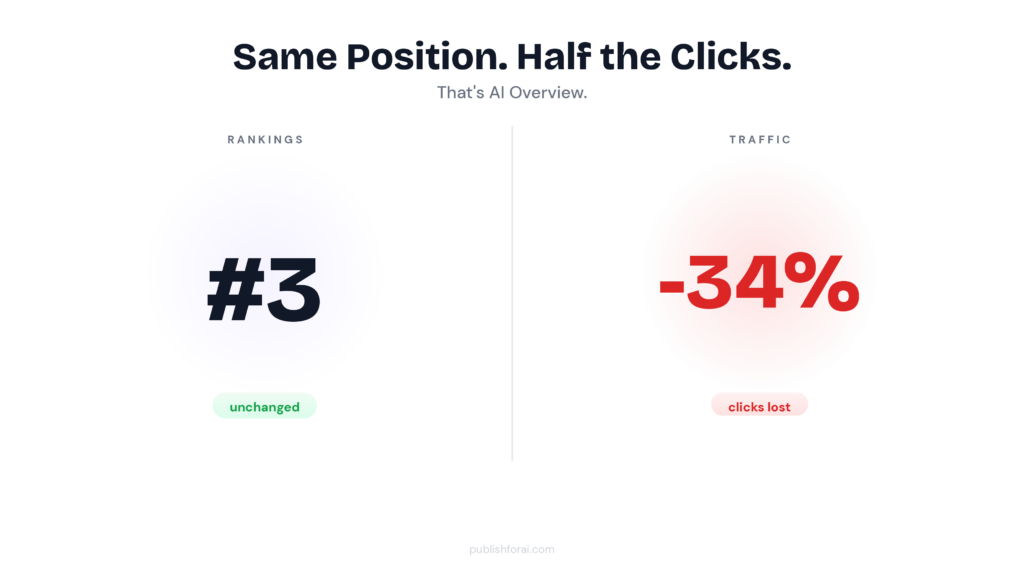
Your website traffic is down. But your rankings haven’t moved. Position 3, page 1, same as always. No penalty, no error in Search Console, no technical issues.
So what’s happening?
Google is now answering your keywords itself, directly in the search results, before anyone clicks. That’s called AI Overview. And it’s quietly, structurally changing what visibility on the web actually means.
I’ve been tracking this shift across client portfolios for the past 18 months. The pattern is always the same: rankings hold, but clicks evaporate.
In this post I’ll explain exactly what Google AI Overview is, which content types are hit hardest, and what you can do to stay visible as a cited source. Not instead of SEO, but on top of it.
What Is Google AI Overview?
Google AI Overview (AIO) is an AI-generated summary that Google has been displaying above organic results for a growing number of queries since 2024. You type a question, Google answers it. Immediately, fully, in its own words.
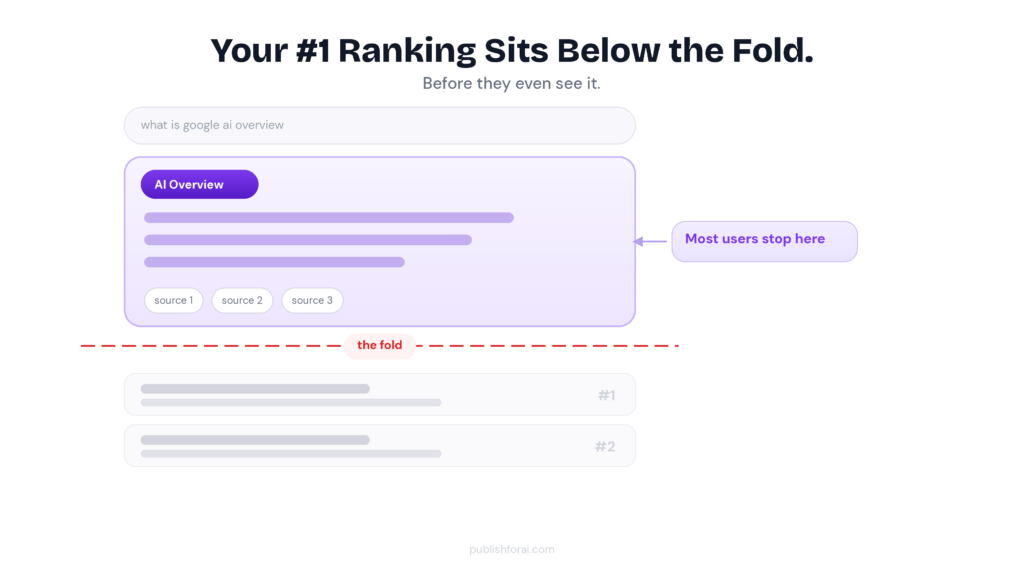
The key detail: Google pulls this answer from multiple sources and presents it as a standalone block. Sometimes it links to those sources underneath. Often it doesn’t. And once the answer is already on the screen, most people don’t scroll.
AI Overviews appear most frequently for questions (What is…?, How does…?, Why…), comparison queries (X vs. Y, difference between A and B), how-to searches, and definitions or explanations.
This isn’t a test anymore. AI Overviews are live across the US, UK, and most major markets, and they’re showing up for a rapidly growing share of keywords. If you publish informational content, you’re directly affected.
Why Am I Losing Traffic Even Though My Rankings Haven’t Changed?
This is the question showing up in every publisher forum in 2026. The answer is simple, just uncomfortable.
Your ranking tells you where your page appears in search results. Your clicks depend on whether anyone scrolls far enough to see it.
AI Overview sits at the top. Before your blue link result enters the user’s line of sight, they’ve already got their answer. That’s zero-click search, and in 2026 it’s not an edge case. It’s mainstream.
Studies analyzing thousands of keywords show that affected queries lose 20 to 40 percent of their organic clicks once an AI Overview appears above them. For informational content like guides, explanations, and how-tos, the drop is even steeper.
I’ve had this conversation with more publishers than I can count this year. That means your traffic loss isn’t a sign you’ve done something wrong. It’s a sign the rules changed.
Which Content Types Are Hardest Hit?
Not every page feels this equally. There’s a clear pattern.
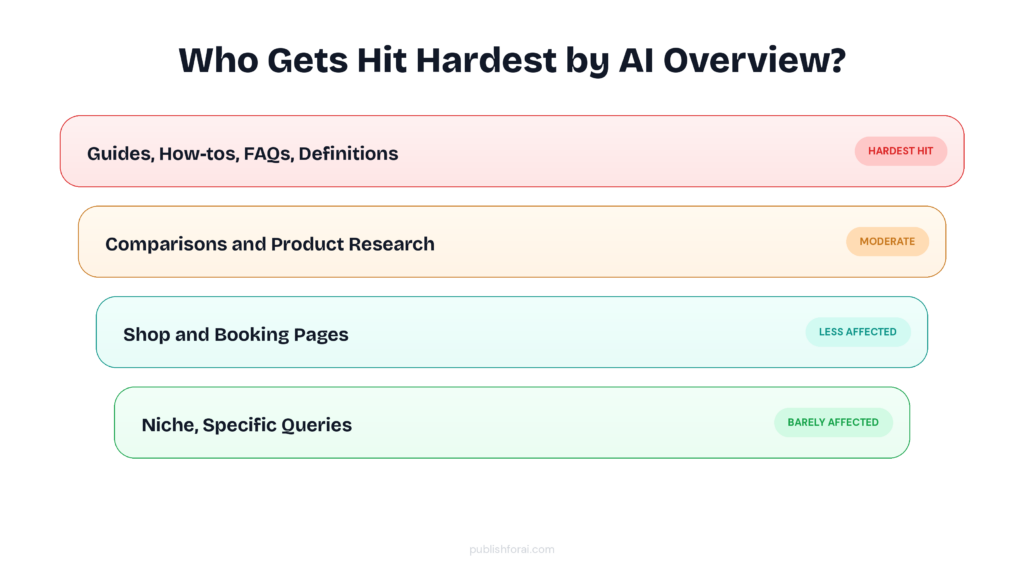
Informational content is hardest hit. Guides, how-tos, definitions, explanations, FAQs. Everything Google can now answer itself. This is exactly the content that bloggers and content teams spent years building, and it’s the most exposed to AI Overviews.
Comparison content and product research are moderately affected. AI Overviews show up here too, but users click through more often because they have specific purchase intent and want to read deeper.
Transactional content like shop pages, booking pages, and specific product pages is less affected. When the user is already in buy mode, Google shows AI Overviews less frequently.
Very specific, niche queries with limited available sources are barely affected at all. The more specialized the topic, the less material Google has to build an AI Overview from, and the more likely organic results remain the first stop.
The uncomfortable truth: publishers who spent the last few years producing high-volume general advice content are the most vulnerable. Not because the content is bad, but because it’s exactly the territory Google is now occupying itself.
How Does Google Decide Which Sources To Cite?
This is the important question, and the good news is there’s an answer.
Google doesn’t select AI Overview sources randomly. There are clear, observable patterns that determine whether a page gets cited or skipped.
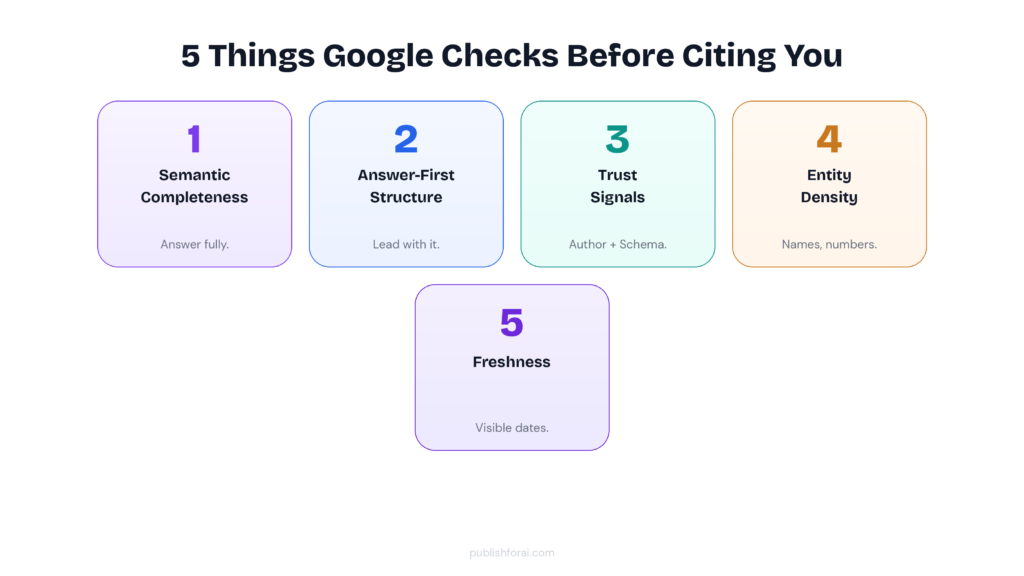
Semantic completeness. Pages that fully answer a question without sending the reader elsewhere get prioritized. Google calls this “information gain”: the unique value your page adds beyond what already exists on the web. AI-generated content scores near zero here because it’s all remixed from existing sources. Original, complete answers score high.
Answer-first structure. Content with direct answers at the start of each section gets extracted far more often. Research shows that 44% of all AI citations come from the first 30% of a page. If your answer is buried in paragraph three, someone else’s opening line gets quoted instead.
Trust signals. A named author with verifiable credentials, structured data (Schema Markup), HTTPS. All of this feeds into source selection. Anonymous content with no visible authorship gets cited less.
Entity density. Specific names, places, dates, numbers. Pages that use concrete, verifiable details instead of phrases like “a leading company” or “some experts” get prioritized. Google’s AI systems map content to its Knowledge Graph using entities. Vague content doesn’t map to anything.
Freshness. Perplexity indexes the live web in real time. Google’s AI Overviews also favor recently updated content. A post updated last week with current data outranks a perfectly structured article from two years ago.
Most pages that don’t get cited aren’t failing on one factor. They’re failing on a combination. Weak structure, generic language, no visible author. Each of those costs points in a system that rewards specificity and trust.
SEO Alone Isn’t Enough Anymore. What Is GEO and How Does It Help?
Here’s the term you need to know in 2026: GEO, short for Generative Engine Optimization.
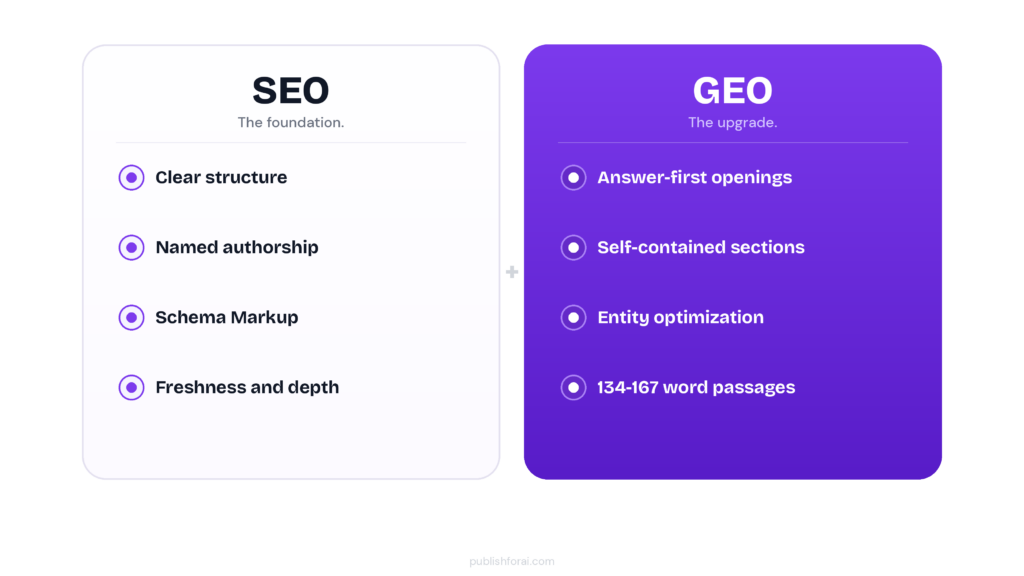
SEO optimizes for Google finding and ranking your page. GEO optimizes for ChatGPT, Perplexity, and Google AI Overview citing your page. Two different goals, with more overlap than you’d expect.
I’ve spent two decades in SEO. GEO isn’t replacing what I do. It’s completing it.
What SEO and GEO share: clear and well-structured content, trustworthy authorship, technical fundamentals like Schema and HTTPS, and a commitment to depth and freshness.
What GEO adds on top: an answer-first structure with no long wind-ups, self-contained sections where each paragraph makes sense without surrounding context, entity optimization instead of keyword repetition, extractable passage length (the research-backed sweet spot is 134 to 167 words per section), and a visible author identity with verifiable credentials.
The key insight: what makes your content citable by AI Overviews almost always improves your Google ranking at the same time. GEO isn’t a competitor to SEO. It’s the upgrade that completes SEO in 2026.
Optimizing for one without the other means leaving half the table empty.
How To Optimize Your Content for Google AI Overview
Let me keep this practical. These aren’t abstract principles. These are specific changes you can make to existing articles this week.
Start with your answer, not your introduction. Every H2 section should open with a direct, quotable statement. Not “In this section we’ll explore why…” but “Google AI Overview appears for queries where…” The first sentence under each heading is your best candidate for an AI citation.
Build self-contained sections. Write every section so it stands alone, complete and useful without the rest of the article. No forward references, no backward ones. AI engines extract passages, not pages.
Name things specifically. Instead of “some studies show,” write “a Graphite analysis of 65,000 URLs found.” Instead of “many users,” write “according to recent data, 62% of users.” Specificity isn’t a stylistic preference. It’s a ranking signal.
Add a FAQ section. AI Overviews frequently pull from FAQ blocks. Think about the three to five questions your reader still has and answer each one directly, in 80 to 120 words.
Make your author visible. Who wrote this article? What’s their background? Where else are they online? An author block at the bottom, linked to a full author page, isn’t a nice extra. It’s a trust signal that AI engines actively evaluate.
Show your update date. “Last updated: March 2026” isn’t fine print. It’s a freshness signal. Update your highest-value pages every three to four months and make the date visible.
Implement Schema Markup. Article Schema, Author Schema, FAQ Schema. These structured data types help Google map your content precisely. This isn’t an enterprise-only move. It’s a few hours of setup with measurable impact.
Tools That Help
Doing this manually is possible, but slow, especially if you’re retroactively optimizing a backlog of existing posts.
👉 Yoast SEO and Rank Math handle Schema Markup and the technical foundation. Both are solid for classic SEO but neither has GEO functionality.
👉 Surfer SEO and Frase help with keyword structure and content briefs. Good for Google rankings, but no AI citability analysis.
👉 Publish for AI is the only tool that combines SEO and GEO in one workflow. You import an existing article, get a combined SEO and GEO score, and see exactly which sections are too vague, too long, or too poorly structured to be cited by AI Overviews, while simultaneously improving your classic Google ranking. One pass, two channels. That’s not an either-or. It’s an upgrade.
It’s the workflow I wish I’d had ten years ago when I was doing this manually for enterprise clients.
The Bottom Line
AI Overview isn’t a temporary beta. It’s the new reality of Google Search, and it’s changing what “being visible” actually means.
If you’re only watching rankings, you’re measuring the wrong thing. The real goal isn’t position 3 anymore. It’s being the source Google builds its answer from.
That requires a different way of writing. More specific, more structured, with a named author and a current date, with sections that work without context, with concrete numbers instead of generic prose.
In 21 years of search, I’ve seen three major shifts. This is the biggest one. But the publishers who move now will come out ahead.
The good news: these changes are doable. And most of them improve your Google ranking at the same time, because what works for AI citability almost always works for classic SEO too. Double the benefit, one workflow.
Start with your most-read article. Audit it for structure, authorship, and specificity. Then do the same for the next one. Or skip the manual part entirely.
👉 Analyze your most-read article in Publish for AI now and see exactly what’s making it uncitable by AI Overview.
Key Takeaways
- AI Overviews cost affected keywords 20 to 40 percent of their clicks, even when rankings don’t move.
- Informational content is hardest hit: guides, how-tos, FAQs, definitions.
- Google cites sources with semantic completeness, answer-first structure, named authorship, entity density, and fresh content.
- GEO is not an alternative to SEO. It’s the layer that completes it.
- Quick wins: answer-first openings, self-contained sections, FAQ block, visible author, Schema Markup, update date.
- What works for AI citability almost always improves your Google ranking too.
FAQ
What’s the difference between Google AI Overview and Featured Snippets?
Featured Snippets show a single text block from one source with a direct link. Google AI Overview combines information from multiple sources and generates an original answer. Featured Snippets have existed since 2014. AI Overviews are the newer, AI-generated format that rolled out globally in 2024. Both appear above organic results, but AI Overviews are typically more prominent and more comprehensive.
Can I stop Google from using my content in AI Overviews?
Technically, yes. You can block Google’s crawler via robots.txt or use the nosnippet meta tag. That prevents your content from being used in AI Overviews, but it also prevents you from benefiting from that visibility and may affect your classic rankings too. For most publishers, blocking isn’t the right move. The better answer is to optimize to get cited.
How long does it take for changes to show up in AI Overviews?
Faster than classic SEO. AI Overviews are based on Google’s current index, and changes to an article can be reflected in source selection within days to a few weeks. Perplexity indexes even faster. GEO optimizations often show results more quickly than ranking improvements in classic SEO.
Does SEO matter less now that AI Overviews exist?
No, but it’s no longer enough on its own. The technical foundations that drive Google rankings are the same ones that drive AI citability: structure, authorship, freshness, relevance. SEO is the foundation. GEO is the floor above it. Build only the foundation and you’re losing reach in a channel that’s growing fast.
Which industries are most affected by AI Overviews?
Any industry with a high share of informational content: health, finance, travel, legal, education, software and tech, marketing. Industries with primarily transactional content like e-commerce and local services are less affected so far, but that’s changing gradually as AI Overviews expand into more query types.
Should I write new articles or optimize existing ones?
Optimizing existing articles is almost always faster and more effective. A well-positioned article that already has traffic usually just needs structural adjustments: answer-first openings, a FAQ block, an author section, Schema Markup. Writing from scratch only makes sense if the article is fundamentally outdated or poorly structured at its core.