
Why is my well-optimized article not being cited by ChatGPT, Perplexity, or Google AI Overviews?
AI search engines evaluate two layers before deciding what to cite. The on-page layer (structure, headings, extractable answers) determines whether your content can be parsed and understood. The off-site layer (brand mentions, community references, citations across the web) determines whether the AI considers your source trustworthy enough to quote. A perfectly structured article without off-site validation may stay invisible because the AI has no external signals confirming it should trust the source.
Your article is structured perfectly. Headings are clean, the intro answers the query, there’s a comparison table, the schema is valid. By every on-page standard, this thing should be getting cited by ChatGPT, Perplexity, and Google AI Overviews.
But it’s not.
You check again. Content is fresh. It’s better than half the results that are showing up. And still: nothing.
The on-page work is doing exactly what it should. Without it, AI couldn’t parse your content in the first place, and you’d have zero chance of being cited. That’s why getting the structure right is non-negotiable. But here’s the part that often gets missed: parseable doesn’t automatically mean citable. AI search engines run a second evaluation on top of the structural one, and that’s where most publishers are losing visibility they don’t even know they’re losing.
How Do AI Search Engines Actually Decide Which Sources to Cite?
AI search engines like ChatGPT, Perplexity, and Google’s AI Overviews don’t just repackage Google’s top results. They run their own retrieval pipelines, pulling from indexed pages, then doing something traditional search never really did at this scale: they cross-check.
The AI generates a potential answer and then goes looking for documents that corroborate what it just said. It’s not asking “is this content relevant?” It’s asking “can I verify this content against other sources?” This process (sometimes called corroboration, sometimes source validation) is a fundamental shift from how we used to think about search.
In traditional SEO, your page competed on its own merits. In AI search, your page competes as part of a network. The AI is essentially asking: does the wider web agree that this source knows what it’s talking about?
The data backs this up clearly. Ahrefs analyzed 75,000 brands and found that branded web mentions show a correlation of 0.664 with AI Overview brand visibility, while backlinks correlate at just 0.218. That’s roughly three times stronger. Their follow-up study across ChatGPT, AI Mode, and AI Overviews found that YouTube mentions correlated even more strongly (around 0.737), reinforcing the same pattern: where your brand appears across the web matters significantly more than how many links point to your domain.
Even more telling: a Semrush analysis found that roughly 60% of AI Overview citations come from URLs that aren’t even ranking in Google’s top 20 organic results. AI systems aren’t mirroring your Google rankings. They’re building their own picture of source credibility, and they’re using off-site signals to do it.
On-Page and Off-Site: Two Jobs, Same Goal
A useful way to think about this: on-page optimization tells the AI what your content contains. Off-site signals tell the AI whether to trust it. Both are needed. They do different jobs.
On-page is your résumé. It shows the AI your qualifications, your experience, the work you’ve done. It makes you legible to the system. Without it, you’re just a stack of unstructured text the AI struggles to parse, and you don’t make the consideration set at all.
Off-site is what happens when someone actually picks up the phone and calls your references. It’s the external corroboration that turns a well-structured page into a credible source the AI is willing to quote.
The résumé gets you into the pile. The references get you the job. Both matter, and skipping either one leaves visibility on the table.
This is exactly why we built Publish for AI to handle the on-page layer first: get the structure right, get the answers extractable, get the AI to actually understand what’s on the page. That’s foundational. The off-site layer extends that work, helping the same well-structured article earn the trust signals that AI uses to decide between equally well-structured competitors.
The 3 Off-Site Signals That Actually Move the Needle
Not all off-site signals carry equal weight. Three categories stand out based on the current research and how retrieval-augmented generation systems actually work.
1. Community Presence
When your content shows up in Reddit threads, niche forums, Quora answers, or specialized community discussions, that’s one of the strongest off-site signals AI models pick up on. Not because these platforms are inherently authoritative, but because they represent organic, independent validation.
The numbers here are striking. Semrush’s analysis found that Reddit dominates ChatGPT citations across professional verticals: it appears in 141% more responses for business services, 122% more for technology, and 127% more for consumer electronics than other source categories. And in a separate 13-week tracking study of 230,000 prompts, Semrush observed that ChatGPT cited Reddit in close to 60% of responses in early August 2025, before that share dropped to about 10% by mid-September. The volatility is real, but Reddit and similar community platforms remain top citation sources across all major LLMs.
The key word is organic. Dropping a link to your own article in a random thread doesn’t create the signal AI is looking for. What matters is whether your content gets referenced as a genuine answer to someone’s question, by someone who isn’t you. That kind of mention is hard to fake at scale, which is precisely why AI systems weight it so heavily.
2. Evidence and Citations
This signal works in both directions. When your article cites external, verifiable sources (data, studies, named experts), it gains credibility because you’re participating in the web’s information ecosystem instead of operating in isolation. You’re creating verifiable claims the model can cross-reference.
The more powerful version is when other sites cite your data. If you publish original research, a unique dataset, a proprietary framework, or a genuinely novel analysis, and other publishers start referencing it, you create a trust network around your content. Every external citation becomes another node in the corroboration web AI uses to evaluate whether a source is worth quoting.
This is why original data is so disproportionately valuable in the AI search landscape. A blog post that summarizes existing information competes with thousands of other summaries. A blog post that contains information others reference becomes a primary source. And primary sources are exactly what AI systems prefer to cite.
3. Ecosystem Visibility
This is the broadest category, covering all the places your domain or brand appears outside your own website. Industry directories, roundup articles, “best of” lists, guest contributions, podcast mentions, newsletter features, YouTube references. Every touchpoint where your brand name appears in a relevant context adds to your ecosystem visibility.
AI systems build entity profiles (essentially, an understanding of who you are and what you’re known for) from the totality of web mentions they can find. The more contexts in which your brand appears alongside your core topic, the stronger that entity association becomes.
A cybersecurity company that only exists on its own blog is essentially invisible to AI. The same company, mentioned in three trade publications, listed in two industry directories, featured in a comparison roundup, and discussed in a relevant subreddit, is a brand AI can identify, classify, and (crucially) cite with confidence.
Why This Isn’t Just Linkbuilding With a New Coat of Paint
If you’ve been doing SEO for a while, this might sound suspiciously familiar. Off-site signals, external mentions, building authority beyond your own domain. Isn’t this just linkbuilding rebranded?
No. The distinction actually matters.
Traditional linkbuilding focused on volume and domain authority. The goal was to accumulate as many backlinks as possible from high-DA sites, regardless of whether the linking context was relevant. You could write a guest post on an unrelated site, get a backlink in the author bio, and call it a win.
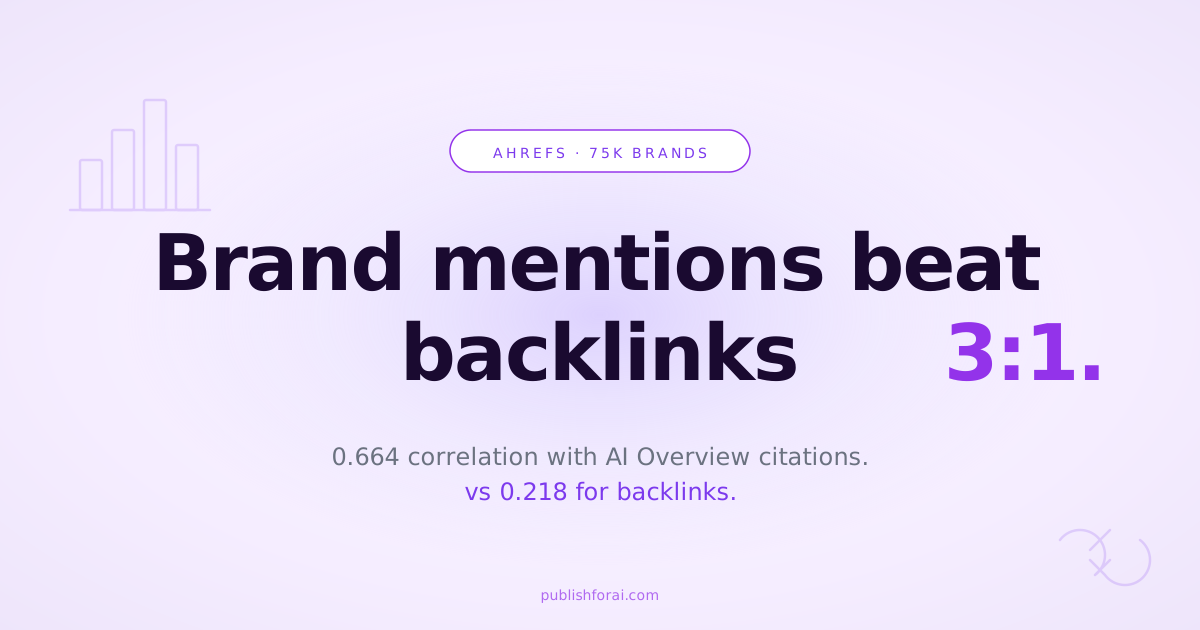
AI search engines don’t operate that way. The Ahrefs data is unambiguous: branded web mentions correlate with AI Overview visibility three times more strongly than total backlinks. A single Reddit comment in a relevant subreddit, where someone with genuine expertise mentions your article as the go-to resource, can create a stronger corroboration signal than fifty guest posts on irrelevant sites.
What AI models respond to isn’t volume. It’s pattern recognition across contexts. They’re asking: does this source keep appearing in conversations actually relevant to the query? Do independent voices confirm what this source claims? Is there a consistent narrative about this brand’s expertise in a specific area?
That’s closer to how humans assess credibility in real life. You trust a restaurant recommendation from a friend who loves food more than you trust a random listing in a directory of ten thousand restaurants. AI works similarly. The relevance and quality of the context matters far more than the quantity of mentions.
How to Build Off-Site Signals Without Burning Out
Understanding the concept is one thing. Acting on it is another. A practical approach starts with mapping where your audience actually discusses your topic.
If you write about personal finance, that might be specific subreddits, a few niche forums, particular LinkedIn communities. If you cover B2B software, it might be industry Slack groups, G2 reviews, trade publications. The platforms vary by niche, but the principle holds: go where the relevant conversations are already happening.
Then contribute genuinely. Answer questions with real expertise. Share your data when it’s relevant. Be helpful in contexts where there’s no direct benefit to you beyond building presence. This is slow work, and it should be, because the signals it creates are only valuable because they’re hard to manufacture.
On the citations side, invest in creating content that others want to reference. Original data, unique analyses, frameworks that solve real problems. If your content is the kind that other writers cite when they need to back up a claim, you’re building corroboration passively.
For ecosystem visibility, audit your brand’s presence across the web. Are you listed in the directories that matter for your niche? Have you contributed to the publications your audience reads? Does your brand appear in the roundups and comparison pages AI systems frequently pull from? If the answer is no, that’s basically your to-do list.
Key Takeaways
- ✓AI search engines use a two-layer evaluation: on-page structure for understanding, off-site signals for trust validation.
- ✓Branded web mentions show a 0.664 correlation with AI Overview visibility, three times stronger than backlinks at 0.218 (Ahrefs study of 75,000 brands).
- ✓About 60% of AI Overview citations come from URLs that aren’t ranking in Google’s top 20 organic results (Stan Ventures analysis).
- ✓Reddit alone was cited in close to 60% of ChatGPT responses in early August 2025, before the share dropped to 10% by mid-September (Semrush 230,000-prompt study).
- ✓The three off-site signals that move the needle: community presence, evidence and citations, and ecosystem visibility.
- ✓Off-site work doesn’t replace on-page optimization. It compounds it.
What This Means for Publishers in 2026
The publishers winning in AI search aren’t the ones doing on-page or off-site work. They’re the ones doing both, and treating them as two halves of the same system. Strong on-page makes your article eligible for citation. Strong off-site signals make it preferred over equally eligible competitors.
This is also why we extended Publish for AI with an Off-Site Visibility section, sitting alongside the on-page optimization that’s been the core of what we do. It analyzes how your content and domain appear beyond your own site, from community mentions to citation patterns to ecosystem presence, and shows you exactly where the gaps are. The on-page work makes you findable. The off-site work makes you trusted. We wanted both in one place.
The good news: if you’ve been creating quality content for years, you probably already have some of these signals working in your favor. The question is whether you’re being intentional about them, or just leaving them to chance.
Run one article through Publish for AI and see exactly where it stands across both layers. What’s already working, what’s not, and what to fix first.
Frequently Asked Questions
Off-site signals are any mentions, references, discussions, or citations of your content or brand that appear on external websites, platforms, and communities. AI search engines use these signals to verify whether a source is trustworthy enough to cite in generated answers. They sit alongside on-page signals (structure, headings, schema) which determine whether your content can be parsed in the first place.
AI search engines use a process often called corroboration or source validation. After generating a potential answer, they look for documents that confirm and cross-reference the information. Sources that are mentioned, cited, and discussed across multiple independent contexts are more likely to be selected as cited sources. According to Ahrefs research, branded web mentions are the single strongest predictor of AI Overview visibility.
According to Ahrefs’ analysis of 75,000 brands, branded web mentions show a correlation of 0.664 with AI Overview visibility, compared to 0.218 for backlinks. That’s roughly three times stronger. Backlinks still matter for traditional SEO, but for AI citation specifically, contextual mentions carry significantly more weight.
No. Traditional linkbuilding focused on backlink volume and domain authority. AI search optimization focuses on contextual relevance: whether your brand is mentioned and discussed in genuinely relevant communities, publications, and contexts. Brand mentions without links can carry more weight than backlinks from irrelevant sites.
Three categories have the strongest impact: community presence (being discussed in relevant Reddit threads, forums, and niche communities), evidence and citations (your content citing verifiable sources, and other sites citing your data), and ecosystem visibility (appearing in directories, roundups, guest contributions, and industry publications relevant to your topic).
No. The two work together. Without strong on-page structure, AI can’t extract clean answers from your content, so it won’t cite you regardless of how well-known your brand is. Without off-site signals, your perfectly structured content lacks the trust validation AI systems use to choose between competing sources. On-page makes you eligible. Off-site makes you preferred.
Yes, when the mention is contextually relevant. AI models evaluate the quality and relevance of where your brand appears, not the volume of links pointing to your site. Semrush’s research found Reddit dominates ChatGPT citations in many professional verticals, and a genuine recommendation in a high-relevance community thread creates a stronger corroboration signal than numerous links from unrelated sources.
Publish for AI now includes an Off-Site Visibility section alongside its on-page optimization tools. It analyzes how your content and domain appear beyond your own website, identifying gaps in community mentions, citation patterns, and ecosystem presence. That gives you a clear picture of where to focus your off-site efforts in addition to the structural optimization PAI handles for your articles.