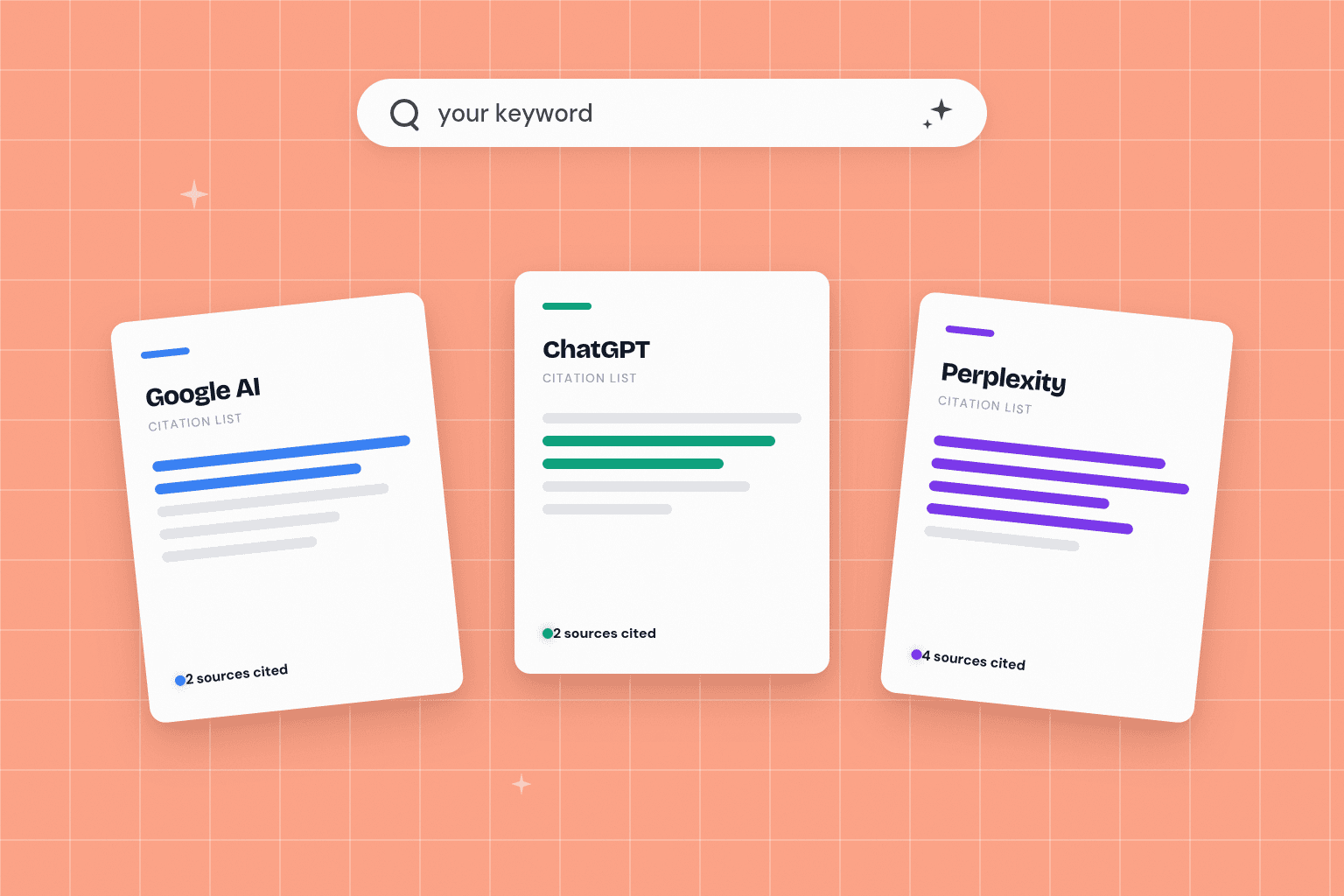
Why do I get cited by Perplexity but not ChatGPT, or the other way around?
Because they’re three different engines, not one. Google AI Overviews runs on Google’s index and rewards extractable passages and schema. ChatGPT runs on Bing’s index and rewards brand mentions and community presence. Perplexity pulls from multiple sources and rewards recency, data density, and topical depth. An article tuned for one can easily be invisible to another. The fix is to know which engine matters most for your audience, optimize for that one first, then layer in the moves that work across all three.
Pull up your strongest article. Take the keyword. Now run it through Google’s AI Overview, then ChatGPT, then Perplexity.
Three different answers. Three different citation lists. Often, three completely different sets of sources.
If you’ve been treating AI search as one battle, that’s the first thing to unlearn. There’s no such thing as “ranking in AI.” There are three engines, three indexes, three sets of selection rules. An article that ChatGPT loves can be invisible to Google AI. A post Perplexity cites within hours of publishing can be ignored by ChatGPT for months.
Same web. Three different filters on it. Once you understand which filter each one uses, you can stop guessing why your citations are uneven and start fixing it.
Why the Three Engines Don’t Agree
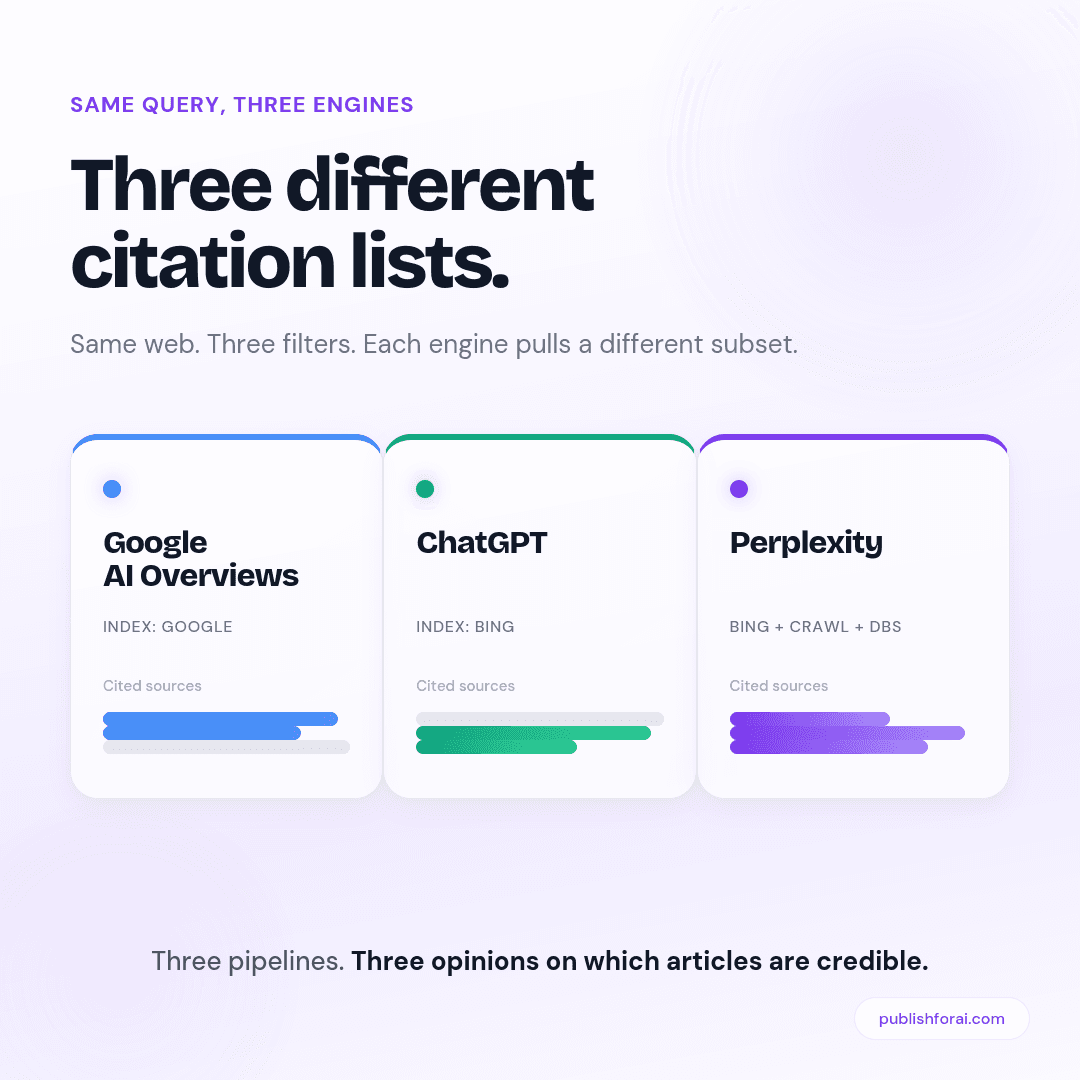
The shortest version: they’re not looking at the same internet.
Google AI Overviews runs on Google’s own index. The same index that powers regular search. So a lot of what you already know about Google ranking still partly applies. AI Overviews just adds a second layer on top: which articles in the SERP are easiest to extract a clean answer from.
ChatGPT runs on Bing’s index when it does a web search. Microsoft’s partnership with OpenAI made this the default. Bing indexes the web differently than Google. Some sites that rank top 10 in Google sit at position 40 in Bing. Some sites Google ignores rank top 5 in Bing. That alone changes the citation pool dramatically.
Perplexity is its own beast. It pulls from multiple sources. Bing-flavored search results, real-time crawls, PDFs, academic databases, sometimes direct content APIs from publishers. It’s also the most aggressive about pulling fresh content within hours of publication.
Google AI Overviews: What It Wants
Of the three, Google AI is closest to classic SEO. The good news: most of what you’ve already done still matters. The catch: a few things matter more than they used to. (For the full breakdown, see what Google AI Overview is and how it picks sources.)
What gets you cited:
1. You rank well in regular Google. Not always #1, but usually somewhere on page one. Google AI doesn’t pull from nowhere. It picks among results it already considers credible.
2. Your schema markup is in order. FAQ schema, HowTo schema, Article schema. Of the three engines, Google AI is the one that actually uses structured data heavily to figure out what your page is about.
3. You answer the question in the first paragraph. AI Overviews extract short, clean passages. If your answer comes after 600 words of intro, you’re invisible. If your first 60 words contain a direct, structured answer, you’re a candidate.
4. Domain authority still pulls weight. Brand strength, backlink profile, age. Google AI inherits Google’s existing trust signals.
5. Recency for time-sensitive queries. “Best laptop 2026” surfaces newer content. Evergreen queries are more forgiving.
The mental model: think of Google AI as a more demanding version of a featured snippet. Same selection criteria, plus extractability.
ChatGPT: What It Wants
ChatGPT is the engine where most publishers are most confused. Because it doesn’t act like Google.
What gets you cited:
1. You rank in Bing. Not Google. This is the single biggest blind spot we see. Publishers obsess over their Google position and never check Bing Webmaster Tools. If Bing doesn’t index you well, ChatGPT can’t see you. (OpenAI also operates its own crawler, OAI-SearchBot, which has ramped up significantly since late 2024. But Bing’s index is still the dominant source for ChatGPT citations in 2026.)
2. Your brand shows up across the web. Mentions, references, links from forums, citations on other sites. ChatGPT weights brand signals heavier than schema. A site mentioned in 50 Reddit threads but with no FAQ schema can outperform a perfectly optimized site with no community presence. (More on this in how to outrank LLMs.)
3. Reddit, Quora, and forums get cited often. This shocks people. ChatGPT pulls from community content far more than Google AI does. If your topic is being discussed on Reddit, get involved there. The discussion itself becomes part of what ChatGPT sees.
4. Long-form, well-structured content holds up. Where Google AI rewards short extractable passages, ChatGPT is more comfortable pulling from longer paragraphs. Don’t compress everything into 50-word chunks for ChatGPT. It can handle context.
5. Recency matters less for general queries. ChatGPT’s web search adds recency, but its base model has training cutoffs. For evergreen topics, an article from two years ago with strong brand signals can outperform a fresh post with none.
The mental model: ChatGPT trusts what the broader web is talking about, not what’s individually best optimized.
Perplexity: What It Wants
Perplexity is the youngest of the three and the most data-hungry.
What gets you cited:
1. Recency. Heaviest of any engine. Perplexity actively prefers content published in the last 30 days for most queries. Articles older than six months get filtered out unless they’re strong evergreen pages.
2. Data density. Statistics, numbers, sources cited inside your article. Perplexity loves articles that already look like research. The more credible sources you cite within your content, the more Perplexity treats you as one.
3. PDFs, GitHub, niche industry sites. Perplexity pulls from places Google buries. Whitepapers, GitHub READMEs, .gov sites, academic preprints, small specialist blogs. The publishing barrier is lower if you’re in a technical or research-heavy niche.
4. Topical depth over domain authority. Perplexity cares less whether you’re a 20-year-old domain. It cares whether your specific article goes deep on the specific question. A focused 2,000-word post on a narrow topic from a small blog can beat a generic 5,000-word post from a household name.
5. Multiple sources per answer. Perplexity typically cites three to seven sources per response. That’s more slots than Google AI (often one to three) and more than ChatGPT (often one to four). Your odds of being one of the cited sources are mathematically better.
The mental model: think of Perplexity as a research assistant, not a search engine. It rewards content that already looks like part of an academic citation chain.
The Side-by-Side
| Google AI Overviews | ChatGPT | Perplexity | |
|---|---|---|---|
| Index | Bing | Bing + real-time crawl + databases | |
| Schema markup | Heavy | Moderate | Light |
| Domain authority | High weight | Moderate weight | Low weight |
| Content length | Short, extractable | Long, structured | Data-dense, deep |
| Recency | Matters for trending queries | Matters less | Matters a lot |
| Forums and Reddit | Rarely cited | Frequently cited | Sometimes cited |
| Sources per answer | 1 to 3 | 1 to 4 | 3 to 7 |
| First-paragraph answer | Critical | Helpful | Helpful |
| Niche / specialist content | Hard to break in | Easier with brand presence | Easiest entry point |
The Unified Play: 5 Moves That Work for All Three
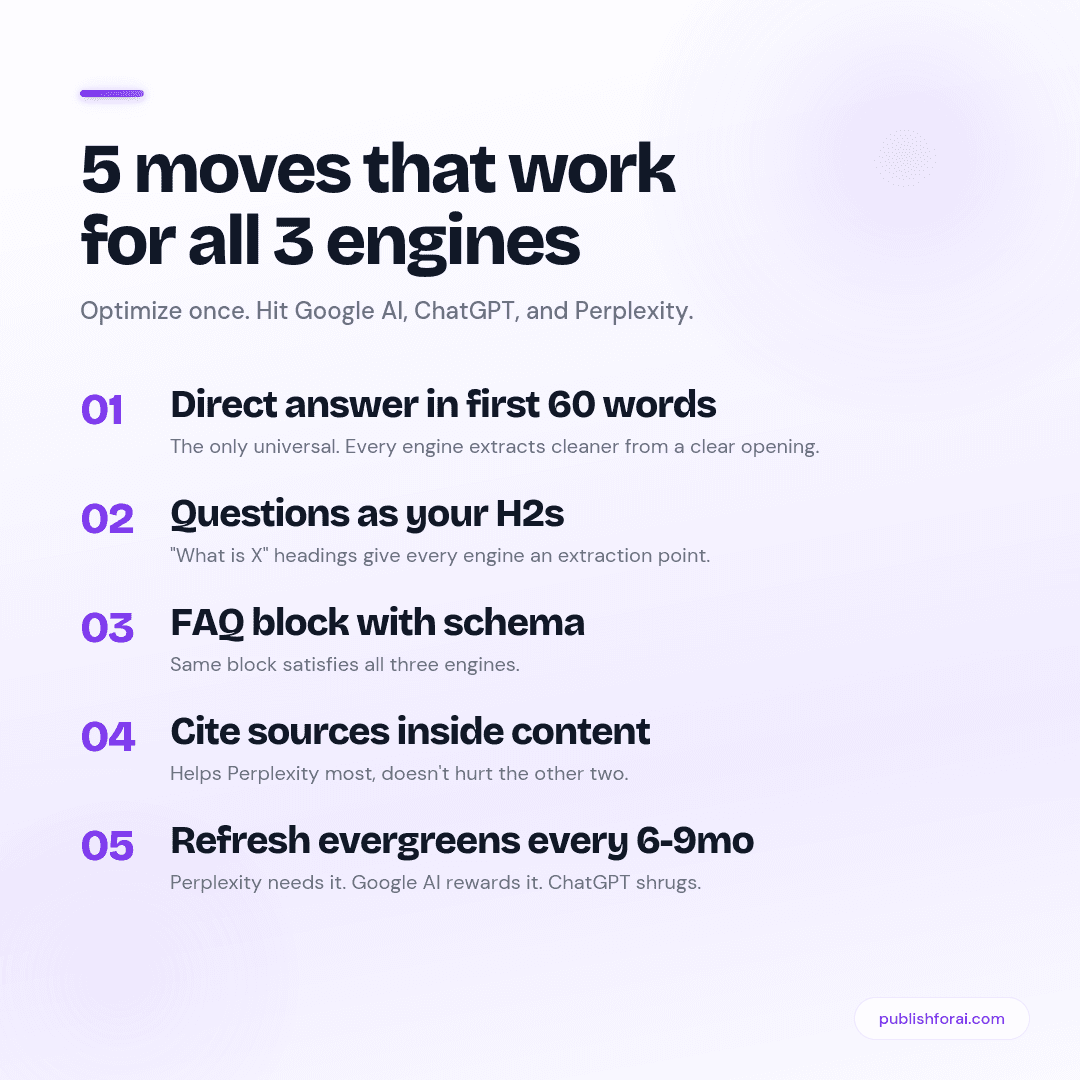
You probably don’t have time to write three different versions of every article. Here’s what to do if you’re optimizing once and want all three engines to take you seriously. (For the deeper version, the 8-step guide to getting cited by AI walks through every move in detail.)
1. Answer the question directly in the first 60 words of your article. This is the only universal. Every engine extracts cleaner from a direct opening.
2. Use questions as your H2s. “What is X” and “How does X work” headings translate well to all three. They give every engine an obvious extraction point.
3. Add a FAQ block. Google AI uses the schema. ChatGPT uses the structure. Perplexity uses the data. Same block satisfies all three.
4. Cite sources inside your content. Real ones, with links. This is single-handedly the move that helps Perplexity most without hurting the other two. ChatGPT also rewards this through brand-association signals.
5. Update your evergreen articles every 6 to 9 months. Refresh the date, add a new stat, tweak the intro. Perplexity needs this badly. Google AI mildly rewards it. ChatGPT doesn’t care, but it doesn’t hurt.
If you can only do one of these, do the first one.
Pick Your Battle
Trying to win all three engines at once is fine for cornerstone articles. But if you’re triaging, pick the one that matters most for your niche and double down.
Affiliate, lifestyle, recipe, travel: Google AI dominates. ChatGPT secondary.
B2B, software, technical, finance: ChatGPT and Perplexity matter more than people think. Especially if your buyers research with AI tools before clicking anything.
Research-heavy, data-driven, specialist: Perplexity is your best entry point. The one engine where small sites can outrank giants on the strength of one well-cited article.
News, time-sensitive: All three care about recency, but Perplexity rewards it most aggressively.
The mistake we see most often is publishers optimizing for Google AI exclusively because that’s what their existing SEO playbook covers. Then they wonder why their traffic still drops while their citation count on ChatGPT and Perplexity stays at zero. You’re playing one game when there are three.
What This Means for Your Next Article
Stop thinking “AI optimization” as one task. Pick the engine your audience is actually using, write for that engine first, then add the unified moves on top.
Most publishers don’t realize how skewed their citation pattern is until they look. Run your top five keywords through Google AI, ChatGPT, and Perplexity this week. Note who’s cited and who isn’t. The pattern is usually obvious within ten minutes. A free AI-readiness check takes about as long and gives you the per-engine starting point.
The gap is usually fixable with a single round of restructuring. The work is structural, not creative. You’re adjusting paragraphs, tightening sources, adding the right schema, rewriting your intro to answer the question in 60 words. You can do it manually one article at a time. Or you can use Publish for AI to get a per-engine plan in one pass and skip the guesswork.
Frequently Asked Questions
Mostly, but not exclusively. ChatGPT’s web search relies primarily on Bing’s index through Microsoft’s partnership with OpenAI. If your site isn’t well-indexed in Bing, ChatGPT typically can’t see it. OpenAI also operates its own crawler called OAI-SearchBot, which has been crawling more aggressively since 2025, suggesting they’re building a supplemental index. But for now, Bing’s index is still the dominant source for what gets cited. Without web search enabled, ChatGPT relies on its training data, which has different cutoffs depending on the model version.
Not automatically. Ranking helps but doesn’t guarantee citation. Google AI picks among top-ranking results based on extractability: how clearly your article answers the specific query in a short, well-structured passage. We see #5 results cited regularly while #1 results get skipped.
Search your top keywords on Perplexity and check the source list at the top of the answer. Perplexity typically shows three to seven sources per query. You can also use citation tracking tools that monitor your domain across all three engines automatically.
Most likely because ChatGPT runs on Bing’s index, where your article may rank much lower. Check Bing Webmaster Tools to see your Bing position. Often the fix is improving your indexing on Bing rather than rewriting content.
Depends on your audience. For consumer queries, Google AI still drives the most traffic. For professional research, Perplexity and ChatGPT increasingly dominate. The smart move is checking which engine your specific audience actually uses, then optimizing primarily for that one.