
How Can I Check If ChatGPT Cites My Content?
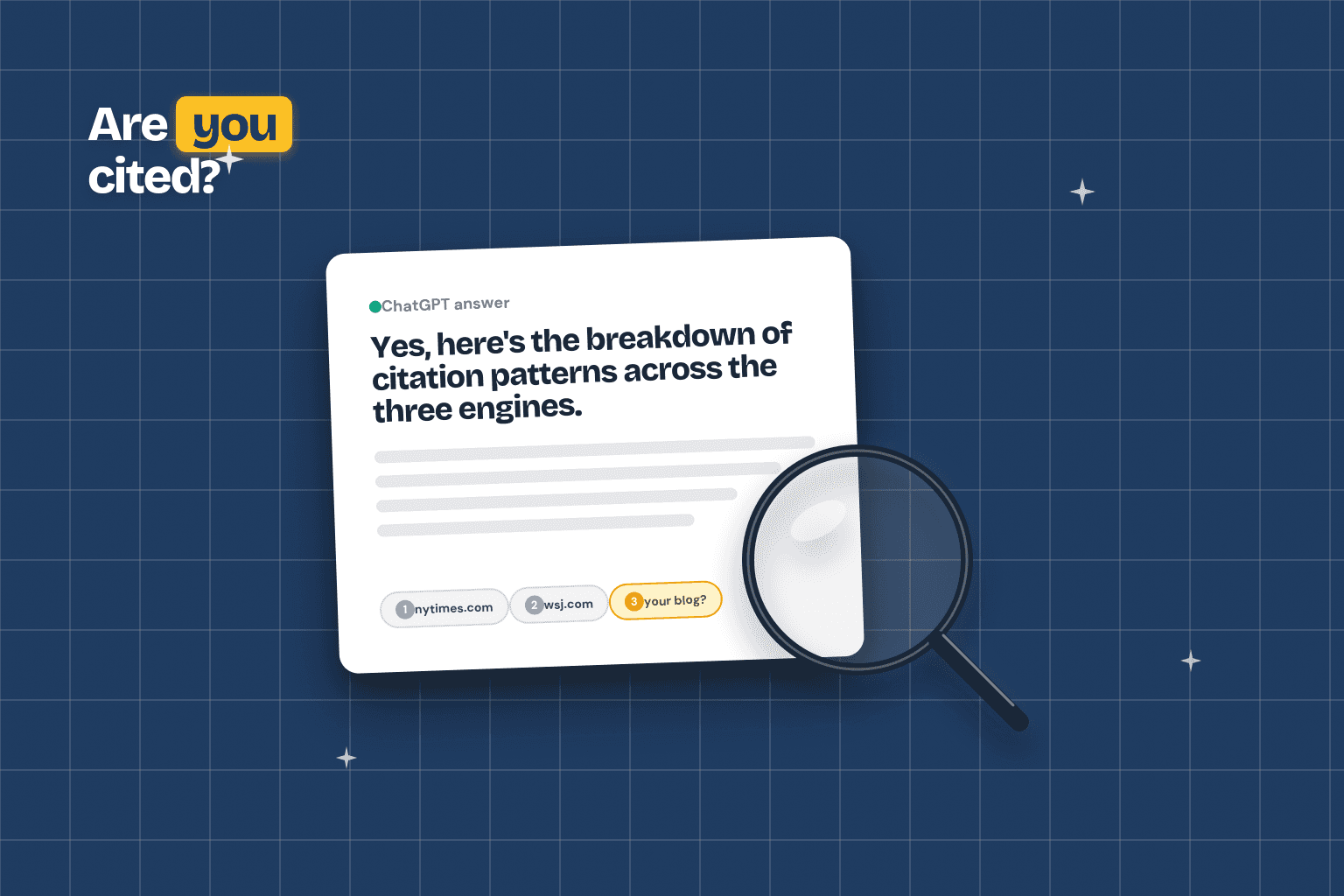
The fastest way to check if ChatGPT cites your content is to ask it a question your article should answer, with web search enabled, and look at the source pills below the answer. Use an incognito window so personalization does not skew results, and try the same question phrased three different ways. For systematic tracking across all your articles, combine three signals: your Bing Webmaster Tools index status, server logs filtered for OAI-SearchBot, and a citation tracking tool that runs scheduled queries.
The Problem Nobody Talks About
You can rank in Google. You can see it in Google Search Console. Click. Done.
AI search works differently. ChatGPT, Perplexity, and Google AI Overviews each cite their own list of sources, and none of them show up in your normal analytics. A reader asks ChatGPT a question. ChatGPT answers and cites your article. The reader closes the tab. You never know it happened.
That gap is the reason most publishers tell us they have “no idea” if their AI optimization work is paying off. They are optimizing in the dark.
This post is the playbook we use ourselves. Manual methods first, automated tracking second, and a clear-eyed look at where each method falls short.
Method 1: Ask the Engine Directly
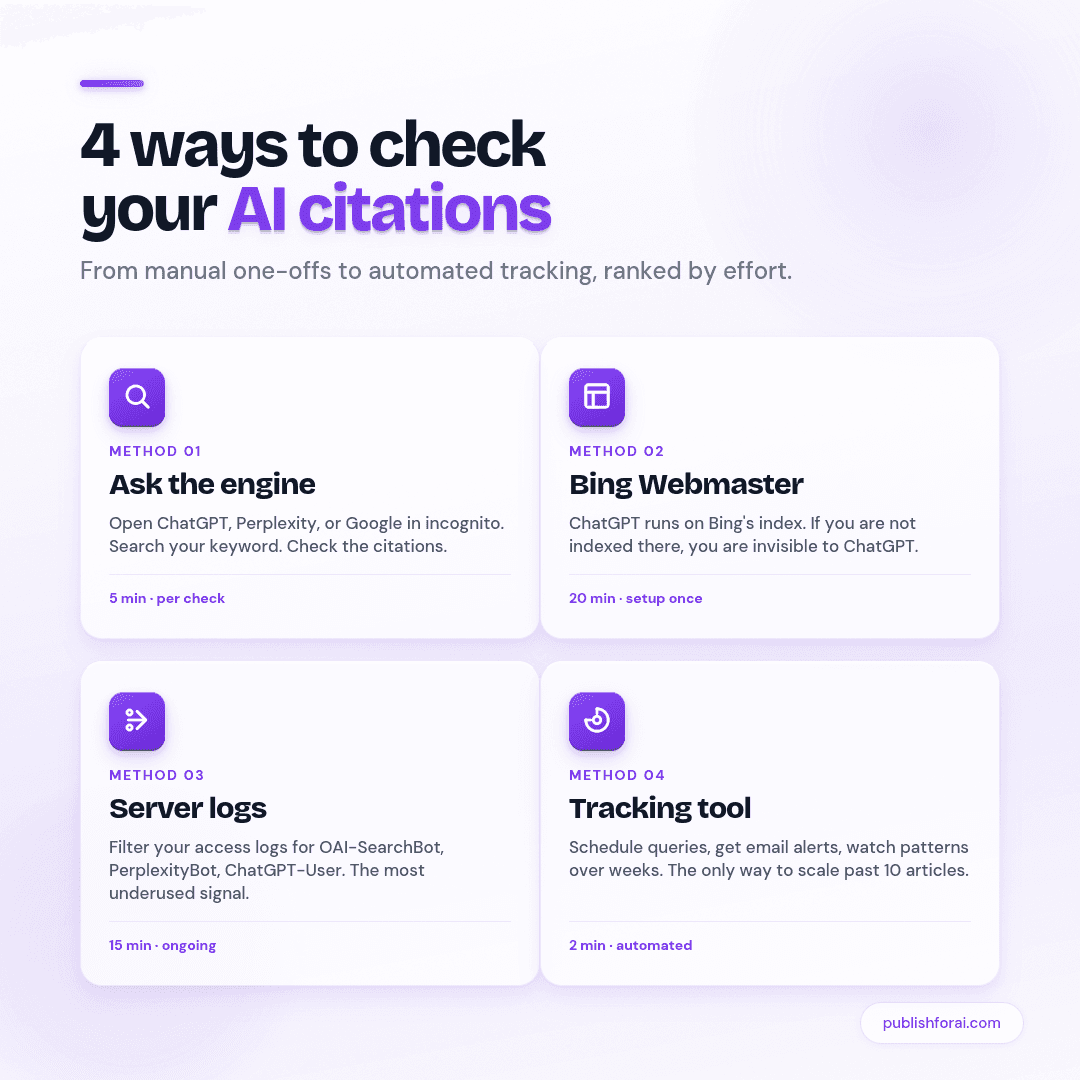
The simplest method is also the most reliable for a single check. Open ChatGPT, Perplexity, or a Google search where AI Overviews trigger. Ask the question your article was written to answer. Look at the citations.
For ChatGPT, turn web search on (the globe icon) and ask a natural question. ChatGPT shows source pills below the answer. Click them and see if your domain is there.
For Perplexity, every answer shows numbered citations. Hover over them to see the source URLs. Perplexity tends to cite 3 to 7 sources per answer, so you have more shots at being included.
For Google AI Overviews, do a normal Google search. If an AI Overview triggers, it has source links on the right side of each block. Click the expand arrow to see all sources.
A few things to know before you start:
Use incognito or logged-out windows. Both ChatGPT and Google personalize results. Your own logged-in answers are not what other people see.
Try the question multiple ways. AI engines often simplify queries before searching. “What are the best auto loan lenders for people with bad credit” might get simplified to “best auto loan lenders bad credit” before the actual search runs. Ask the same question three different ways. Citation patterns often show up only on certain phrasings.
Different days, different answers. AI engines re-rank based on freshness, query simplification, and internal weights that change. A “not cited” today does not mean “not cited tomorrow.” This is the most frustrating thing about manual checks.
Don’t trust a single check. One query is a sample of one. If you want a real read, run five different phrasings of the same intent across two or three days.
Method 2: Check Your Bing Webmaster Tools
This is the move most publishers skip. ChatGPT search runs primarily on Bing’s index, so if you are not indexed in Bing, you cannot be cited by ChatGPT. Period. (For more on why each engine pulls from different sources, see how the three engines actually decide what to cite.)
Most blogs are auto-indexed by Bing within a few days of publication. Being indexed and ranking well are two different things. Pages can sit deep in Bing’s index without ever surfacing in queries.
Set up Bing Webmaster Tools (it is free, takes about 20 minutes), submit your sitemap, and check two things:
- 1.Indexed pages count. Compare it to your Google Search Console indexed count. A big gap means Bing is missing your stuff.
- 2.Top pages report. Which of your pages actually pull traffic from Bing? Those are your ChatGPT-eligible pages. The rest are technically indexed but invisible.
If a key article is missing from Bing, you have a clear fix path. Submit it manually for indexing, check whether technical issues block crawling, look at your robots.txt for OAI-SearchBot and BingBot directives. None of this matters for Google rankings, and all of it gates your ChatGPT citations.
Method 3: Read Your Server Logs
Your server logs tell you which AI bots have visited which pages, when, and how often. This is the most underused signal in the whole AI search game.
The user agents to watch:
- ✓OAI-SearchBot: OpenAI’s search crawler. When it hits your page, OpenAI is potentially preparing to cite you.
- ✓PerplexityBot: Perplexity’s crawler.
- ✓ChatGPT-User: fired when a user inside ChatGPT asks the bot to look at a specific page. This one is a strong signal of actual user interaction.
- ✓Claude-SearchBot: Anthropic’s equivalent.
- ✓Google-Extended: relevant for Google’s AI training, less so for AI Overview citations.
How to find them depends on your stack. On Cloudflare, use the Bot Analytics tab and filter by user agent. On WordPress with a plugin like Wordfence or All-In-One Security, the live traffic view shows visiting bots. On a standard Apache or nginx server, run grep "OAI-SearchBot" access.log and you have your answer.
What to look for:
- ✓Crawl frequency on key articles. If OAI-SearchBot is hitting your top article every few days, that article is in active rotation for ChatGPT answers.
- ✓ChatGPT-User hits. Each one means a real user clicked “browse” on your page from inside ChatGPT. That signal is the closest thing to a confirmed AI citation you can get from your own logs.
- ✓Pages that get zero AI bot traffic. Those are blind spots. Either the AI engines do not know about them, or technical issues are blocking access.
The limit: server logs tell you the bot visited. They do not tell you whether the bot used your content in an answer. That is the missing layer between crawl and citation.
Method 4: Use a Tracking Tool
If you have more than ten articles you want to monitor, manual checks fall apart fast. You need automation, and the choices are uneven.
The categories:
Enterprise platforms (Otterly.ai, Brightdata, ScrapingBee). These run scheduled queries against AI engines and report citation status. Pricing typically starts at $29 per month and goes up to $489 for higher volume. Built for agencies and large teams.
Generic SEO tools with AI features (Ahrefs, Semrush). They have started adding AI Overview tracking to their existing platforms. Decent if you already pay for them. The AI features are bolt-ons, not the core product.
Browser extensions and bookmarklets. Free, manual, useful for spot checks. They are not built for systematic tracking.
Built-in tracking inside an optimization tool. This is the path we built into Publish for AI. Every plan includes a quota of tracked keywords, and you decide which ones to track by toggling a lock on each keyword. For every locked keyword we also track one or more natural-language questions derived from it in parallel, because LLMs are queried conversationally and the question phrasing often gets picked up where the bare keyword does not. The tracker re-checks all of those across Google AI Overviews, ChatGPT, and Perplexity every 14 days, surfaces citation alerts when a keyword or question first gets cited, and preserves the “ever cited” status so you keep the win on record even if the engine’s answer changes the next week.
The honest disclaimer that applies to every tracking tool, ours included: API-based citation checks are sampling. They run the same query the engine would run, and the actual web UIs sometimes use different pipelines. A “not cited” in a tracker does not always mean “not cited in real-world ChatGPT.” Use tracking tools for pattern detection. Treat individual checks as directional.
What None of These Methods Will Tell You
A few honest limits, because the AI search tracking space is full of vendors overpromising:
You cannot count “AI search impressions” the way you count Google impressions. No engine publishes that data. Anyone selling you a precise AI impression count is using proxies and modeling.
You cannot attribute traffic from AI search reliably. Some browsers strip referrers from AI tools. Some users open links in incognito. Even when the referrer comes through (chatgpt.com, perplexity.ai), the click is rare. Most AI search reads happen without a click at all.
You cannot measure brand mentions inside AI answers. Some engines mention brands in their text without citing the source URL. That visibility is real, and no current tool catches it cleanly.
The right framing: AI citation tracking gives you a pulse, not a pulse oximeter. You get directional signal. You see which articles are getting picked up. You spot patterns over weeks. You don’t get a clean attribution chain from query to revenue.
That’s just the reality of where AI search measurement is in 2026. It will get better. For now, work with what we have.
A Practical Weekly Check (10 Minutes)
Here’s the routine we recommend to publishers who want to stay informed without obsessing:
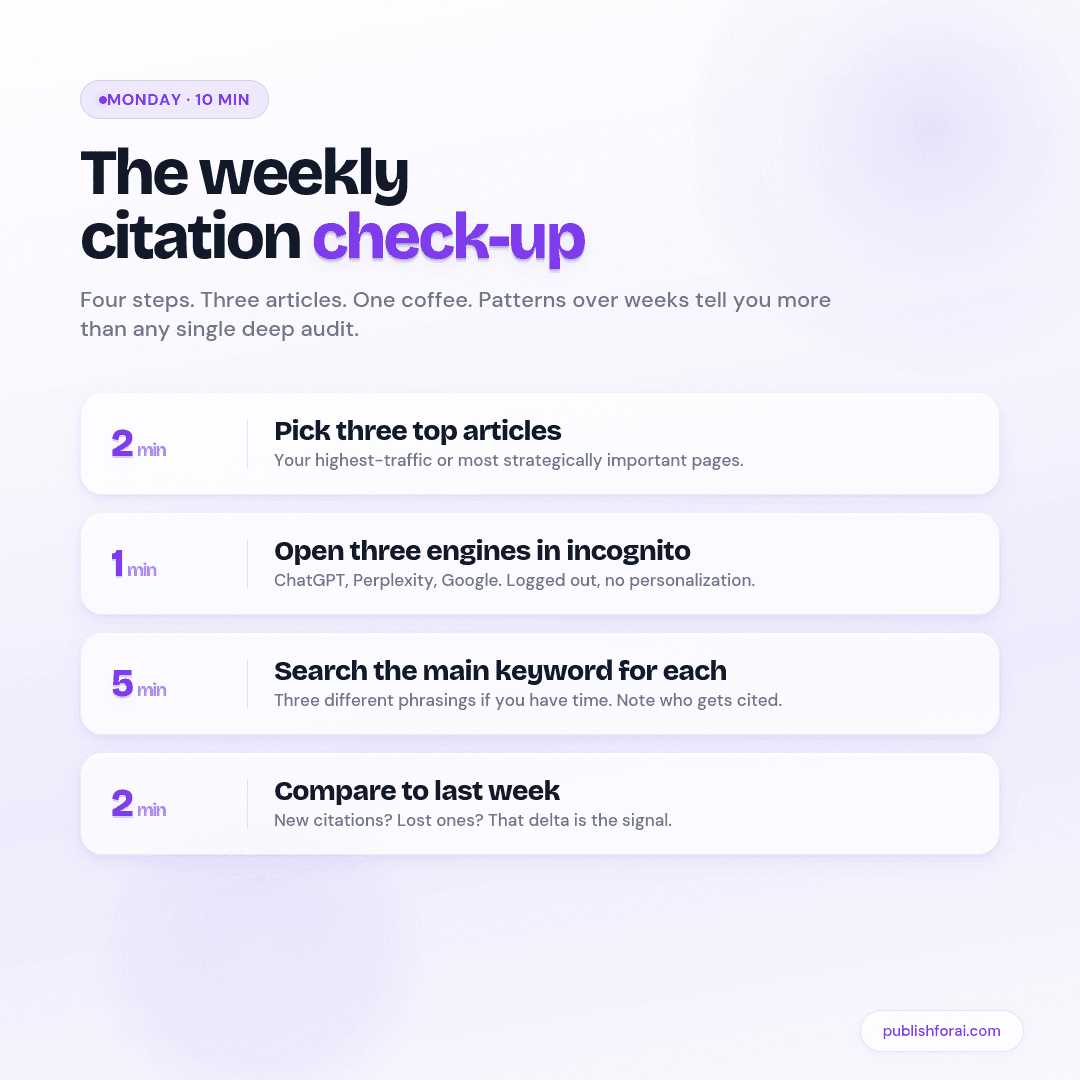
Monday morning, 10 minutes:
- 1.Pick three of your top articles.
- 2.Open ChatGPT, Perplexity, and Google in incognito.
- 3.Search the main keyword for each article.
- 4.Note what gets cited.
- 5.Compare to last week.
That’s it. Five articles per week, twenty per month, gives you a working sample. Over time you will see which articles consistently get picked up, which never do, and which engines favor your content. That pattern is more useful than any single check.
When you spot an article that should be cited and isn’t, that’s the trigger to dig deeper. Look at your Bing index status. Check your structure (does the article answer the question in the first 60 words?). Check your server logs for AI bot traffic on that URL. The 8-step guide to getting cited by AI walks through the structural fixes one by one.
What We Built Into Publish for AI
We obviously have a horse in this race, so here’s the straightforward version. Every Publish for AI plan includes a quota of tracked keywords. You pick which ones to track by toggling a lock on each keyword. For every locked keyword we also run one or more natural-language questions in parallel, because that’s how people actually phrase queries to LLMs, and the question form often catches citations the bare keyword misses. The tracker runs scheduled checks across the three major AI engines, sends you an email the first time a locked keyword or its paired question gets cited on any platform, and shows you which engines pick up your content over time.
It does not replace the manual methods above. You should still check your top articles by hand because the manual check shows you what real users see, and our automated check is sampling. For the long-tail of your content library, where manual checking is impossible, the tracker fills the gap.
If you want to see it in action, you can start with the free tier and it includes citation tracking on two keywords. Enough to test the workflow without committing.
Key Takeaways
- ✓AI citations don’t show up in your normal analytics. You need separate signals to see them.
- ✓The fastest manual check is the engine itself. Ask three phrasings, in incognito, across two or three days.
- ✓Bing Webmaster Tools gates ChatGPT citations. If you’re not indexed in Bing, you can’t be cited.
- ✓Server logs are the most underused signal. Filter for OAI-SearchBot, PerplexityBot, and ChatGPT-User.
- ✓Crawl proves visit, not citation. Logs show the bot came, not whether it used your content.
- ✓Tracking tools give you a pulse, not a pulse oximeter. Use them for patterns, not proof.
- ✓Ten minutes a week beats hours once a quarter. Three articles, three engines, every Monday.
Final Thoughts
Tracking AI citations isn’t the goal. Getting cited is the goal. Tracking just tells you whether your work is paying off.
The publishers who win in 2026 are the ones treating citation tracking like SEO ranking tracking ten years ago: as feedback, not as a vanity metric. Which articles get cited? Why those? What do they do differently from the ones that don’t?
Answer those three questions month over month and you stop guessing. You start optimizing with intent.
That’s the whole game.
Frequently Asked Questions
For your top 5 to 10 articles, weekly manual checks are enough. For everything else, a tracking tool that runs every 1 to 2 weeks gives you the right resolution. Daily checks are overkill, the citations don’t change that fast.
AI engines re-rank based on query phrasing, freshness, and internal weights that update. A single “not cited” result is noise. Patterns over multiple checks across multiple days are signal. This is also why tracking tools give “best ever cited” status, so a single off-day doesn’t erase a real win.
Not directly, and indirectly yes. Look for queries with high impressions and low click-through rate. That pattern often means an AI Overview is appearing for that query and your article is the source. Search Console doesn’t label it explicitly. The impression-without-click signature is the giveaway.
It means OpenAI is interested enough to crawl you regularly, which is a strong precondition for citations. Crawl is not the same as citation. The bot might be indexing you for future use without picking you in current answers. To confirm citations, you still need to run actual queries against ChatGPT.
Yes, and not just for ChatGPT. Bing’s index also feeds Copilot, parts of Perplexity, and other AI tools using Microsoft’s search infrastructure. Setup takes about 20 minutes. The visibility you gain across the AI ecosystem is worth it.
Domain size matters less than you think. About 46% of AI Overview citations come from URLs ranking outside Google’s top 50. AI engines select for extractability, freshness, and direct answers. A small site with sharply structured content beats a big site with rambling articles. The barrier is structural, and it has nothing to do with authority.